

Whether you’re cutting rebar, grinding welds, or polishing metal, your angle grinder is only as good as its core components. Understanding the motor, spindle, guard, and disc helps you pick the right tool and use it safely. Let’s break down each part and what to look for.
The motor is the heart of the grinder, the spindle transfers that power to the disc, the guard protects you from debris, and the disc does the actual work. Get any of these wrong, and your project suffers — or worse, you risk injury. We’ll cover everything so you can choose your next grinder with confidence.
The Motor: Power That Drives Everything
The motor determines how much torque and speed your grinder delivers. Most corded models run on 6 to 15 amps, while cordless grinders rely on voltage (typically 18V to 20V). Higher amps or volts mean more cutting power, but also more weight.
For most DIY tasks, a 7-amp motor is plenty. For heavy-duty metal fabrication, look for 11 amps or more. The DEWALT Angle Grinder, 4.5 Inch, 11 Amp, 11,000 rpm, With Paddle Switch (DWE402) delivers serious torque for prolonged grinding. Its 11-amp motor keeps the rpm steady under load.
Brushless motors (common in cordless models) are more efficient and last longer than brushed motors. The DEWALT 20V MAX Angle Grinder Tool Cordless Brushless (DCG413B) uses a brushless design that runs cooler and extends runtime — ideal if you work without a wall outlet.
Key motor features to consider:
- Amp rating (corded) or voltage (cordless)
- RPM — most grinders run at 10,000–11,000 rpm
- Brush type — brushed vs. brushless
- Dust ejection — keeps debris out of the motor (like the DEWALT DWE402W with dust ejection system)
The Spindle and Arbor: Transferring Power to the Disc
The spindle (also called the arbor) is the threaded shaft that holds the disc. Most 4-1/2-inch grinders use a 5/8-11 arbor (5/8 inch diameter, 11 threads per inch). The spindle locks so you can change discs easily.
The arbor’s job is to spin the disc at high speed while handling side loads from grinding. A sturdy spindle reduces vibration and keeps the disc running true. For a look at how the arbor interacts with the rest of the tool, see our guide on What Does the Arbor Do on an Angle Grinder?
Pro tip: Always match the disc’s arbor hole size to your grinder’s arbor. Many discs come with reducer rings to fit standard 5/8-11 spindles.
The Guard: Your First Line of Defense
The guard (or wheel guard) wraps around the disc to catch sparks, debris, and broken wheel fragments. It’s not optional — using a grinder without a guard is dangerous and violates safety standards.
Guards come in two main types:
- Fixed guards — simple, secure, but harder to adjust
- Tool-free adjustable guards — let you rotate the guard without a wrench
The DEWALT Angle Grinder, One-Touch Guard, 4-1/2-Inch (DWE4011) features a one-touch guard adjustment — you can reposition it with a single lever, no wrench needed. This is a huge time saver on the job.
Guard safety rules:
- Always keep the guard between you and the disc
- Never remove the guard — even for tight spaces
- Check that the guard rotates freely and locks in place
For a deeper look at how guards work alongside other safety features, read Side Handle, Guard, and Anti-vibration Features: What They Do
The Disc: Cutting, Grinding, and Finishing
The disc is the replaceable part that actually touches the material. There are dozens of disc types, but the four most common are:
Grinding Discs
Thick, reinforced wheels (typically 1/4 inch) for removing stock, cleaning welds, and sharpening. Use them on metal and stone.
Cutting Discs
Thinner wheels (around 1/16 inch) for slicing through metal, tile, or concrete. They’re brittle — never use them for grinding.
Flap Discs
Overlapping abrasive flaps that grind and finish in one step. Great for blending surfaces and light stock removal.
Wire Brushes
Cup or wheel brushes for cleaning rust, paint, and scale. Not technically a disc, but they use the same mounting.
Choosing the right disc is critical. The Bosch GWS8-45 4-1/2 In. Angle Grinder is a reliable corded option that handles all these disc types with ease. Its slim grip gives you control when using flap discs for finishing.
Comparing Top Angle Grinders for Every Budget
To help you decide, here’s a side-by-side comparison of the best models on Amazon. Each one excels in different areas — motor power, cordless convenience, or budget value.
| Product | Price | Rating | Key Feature | Buy Now |
|---|---|---|---|---|
 DEWALT DWE402 DEWALT DWE402 |
$94.00 | 4.8 | 11-Amp motor, 11,000 rpm, paddle switch | Buy at Amazon |
 DEWALT DWE4011 DEWALT DWE4011 |
$69.00 | 4.7 | One-touch guard adjustment | Buy at Amazon |
 Bosch GWS8-45 Bosch GWS8-45 |
$62.10 | 4.6 | Compact, 6.0-amp, slim grip | Buy at Amazon |
 DEWALT DCG413B DEWALT DCG413B |
$155.99 | 4.8 | Brushless motor, kickback brake | Buy at Amazon |
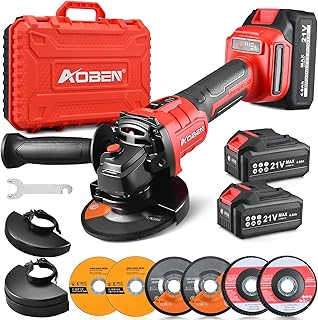 AOBEN Cordless AOBEN Cordless |
$58.48 | 4.5 | 2×4.0Ah batteries, brushless motor | Buy at Amazon |
How These Parts Work Together
The motor generates rotational force, the spindle transfers it to the disc, the guard keeps you safe from the disc’s action, and the disc does the cutting or grinding. It’s a simple mechanical loop that transforms electrical power into material removal.
When you pull the trigger (or press the paddle switch), the motor spins the spindle. The arbor lock (usually a button) prevents the spindle from turning during disc changes. The guard stays stationary while the disc spins inside it. For a complete picture of the power flow, read Inside an Angle Grinder: How Power Turns into Cutting and Grinding
Choosing the Right Parts for Your Project
For heavy metal grinding — Prioritize high amperage (11A+) and a durable guard. The DEWALT DWE402 is a top pick.
For precise cutting — A lighter grinder like the Bosch GWS8-45 gives you better control. Use thin cutting discs.
For cordless freedom — Go with a brushless model like the DEWALT DCG413B or the AOBEN Cordless for budget-friendly runtime.
For safety — Always use a grinder with a working guard. The DEWALT DWE4011’s one-touch guard makes it easy to adjust without skipping the safety step.
Maintenance Tips to Extend Part Life
- Motor — Blow out dust regularly with compressed air. Clean the vents to prevent overheating.
- Spindle — Lubricate the threads occasionally with light oil. Replace if it feels rough when turning.
- Guard — Tighten the locking nut after every disc change. Replace if cracked.
- Disc — Inspect for cracks or wear before each use. Store in a dry place.
A well-maintained angle grinder lasts years. For a quick overview of all components, check out Angle Grinder Anatomy: a Simple Guide to the Main Components
Understanding the motor, spindle, guard, and disc turns you from a casual user into an informed one. You’ll pick the right grinder for the job, use it safely, and get better results. Ready to upgrade? Grab one of the recommended models above and see the difference a quality tool makes.