

Wire wheels are some of the most versatile attachments you can fit on an angle grinder. Whether you’re stripping paint, removing rust, or cleaning up welds, a wire wheel can turn a simple grinder into a powerful surface preparation tool. But with great power comes great responsibility. Wire wheels spin at thousands of RPM, and if you choose the wrong type or use it improperly, you risk kickback, injury, or damage to your workpiece.
In this guide, we’ll cover everything you need to know about wire wheels for angle grinders: their uses, the risks involved, and how to ensure compatibility with your grinder. We’ll also recommend some of the best angle grinders on the market that pair perfectly with wire wheels.
What Are Wire Wheels for Angle Grinders?
Wire wheels—also called wire brushes or cup brushes—are abrasive attachments made of twisted steel wires (or stainless steel, brass, etc.) arranged radially around a central hub. They attach to an angle grinder’s spindle via a 5/8-11 arbor hole (standard for 4-1/2-inch grinders) or via a threaded adapter. When the grinder spins, the wire bristles aggressively abrade the surface.
Wire wheels come in several styles:
- Cup brushes: Flat, circular brushes ideal for large flat surfaces.
- Knotted wire wheels: Aggressive, heavy-duty brushes with twisted wires for intense cleaning.
- Crimped wire wheels: Softer wires for lighter cleaning and polishing.
- End brushes: Cylindrical brushes for corners and tight spots.
| Brush Type | Typical Use | Aggressiveness |
|---|---|---|
| Cup brush | Rust removal, paint stripping on flat surfaces | Medium to high |
| Knotted wheel | Heavy weld cleaning, scale removal | Very high |
| Crimped wheel | Light cleaning, deburring | Low |
| End brush | Detail work, grooves | Medium |
Top Uses for Wire Wheels on an Angle Grinder
Wire wheels excel at tasks that would ruin a grinding disc. Here are the most common applications:
- Rust and corrosion removal – Bring old metal back to bare steel.
- Paint and coating stripping – Quickly strip layers without loading up the brush.
- Weld cleaning – Remove slag, spatter, and oxidation from welded joints.
- Deburring and edge blending – Smooth sharp edges after cutting.
- Concrete and masonry surface prep – Use stainless steel brushes to remove efflorescence or light coatings.
For a deeper dive into which disc or wheel to use for specific jobs, check out our guide on Angle Grinder Disc Types Explained: Which One to Use and When.
Risks of Using Wire Wheels
Wire wheels spin at high speeds (typically 10,000 to 11,000 RPM on a 4-1/2-inch grinder). At those speeds, a wire break can become a dangerous projectile. The main risks include:
- Wire breakage and fly-off – Wires can snap and shoot out with enough force to penetrate skin or eyes. Always wear full PPE: safety glasses, face shield, heavy gloves, and long sleeves.
- Kickback – If a wire wheel catches an edge or snags, the grinder can jerk violently. Use a grinder with a paddle switch and anti-kickback brake for added safety.
- Overloading the grinder – Pushing too hard can overheat the motor. Let the wheel do the work.
- Incorrect speed rating – Using a wire wheel rated for lower than your grinder’s no-load speed can cause the brush to disintegrate. Always match the maximum RPM rating.
Compatibility: Choosing the Right Wire Wheel for Your Grinder
Not every wire wheel fits every grinder. Here’s what to check before you buy:
- Arbor size – Most 4-1/2-inch angle grinders have a 5/8-11 threaded spindle. Ensure your wire wheel has the same arbor hole or use a reducing bushing.
- Wheel diameter – The standard diameter is 4-1/2 inches. Using a larger wheel (e.g., 5-inch) on a 4.5-inch grinder may exceed the guard clearance and cause binding.
- Maximum RPM – Compare the wire wheel’s rated speed to your grinder’s no-load speed. For example, a DEWALT DWE402 spins at 11,000 RPM. Your wire wheel must be rated for at least that.
- Material compatibility – Use stainless steel wire wheels on stainless steel to avoid contamination. Steel wire wheels are fine for carbon steel.
- Grinder power – Heavier cleaning requires a grinder with at least 7–11 amps. Cordless models like the DEWALT DCG413B offer exceptional torque for brushing tasks.
For more on selecting the right wheel size, read How to Choose the Right Wheel Size for an Angle Grinder?.
Safety Tips for Using Wire Wheels
- Always use a guard designed for wire wheels (type 27 guard with a brush guard).
- Inspect the wheel before each use. Replace if wires are bent, broken, or missing.
- Start the grinder away from the workpiece and let it reach full speed before contact.
- Use light, even pressure. Avoid letting the wheel bounce.
- Wear hearing protection — wire wheels are loud.
Best Angle Grinders for Wire Wheel Work
To get the most out of wire wheels, you need a reliable grinder. Here are top-rated models that offer the power, speed, and safety features essential for wire brushing.
1. DEWALT DWE402 – 4.5-Inch, 11 Amp, 11,000 RPM

The DEWALT DWE402 is the gold standard for wire wheel work. Its 11-amp motor delivers 11,000 RPM with plenty of torque to power through heavy rust and scale. The paddle switch provides intuitive kickback control, and the ergonomic compact design reduces fatigue during extended brushing sessions.
2. DEWALT DWE4011 – 4-1/2-Inch with One-Touch Guard

For quick guard adjustments without a wrench, the DEWALT DWE4011 is a smart choice. Its 6-amp motor (11,000 RPM) is lighter but still sufficient for light-to-medium wire brushing. The one-touch guard makes switching between wire wheels and cutting discs hassle-free.
3. Bosch GWS8-45 – 4-1/2-Inch, 7.5 Amp

The Bosch GWS8-45 is a compact, lightweight grinder with a 7.5-amp motor. It runs at 11,000 RPM and is built for durability. The slim barrel grip offers excellent control, making it ideal for precision wire brushing on smaller surfaces.
4. DEWALT DCG413B – 20V MAX Cordless Brushless

If you need cordless freedom, the DEWALT DCG413B delivers brushless power and up to 9,000 RPM. It features Kickback Brake technology that stops the wheel instantly if a bind is detected — a huge safety plus when using aggressive wire wheels.
5. AOBEN Cordless Angle Grinder Kit – 21V, 2×4.0Ah
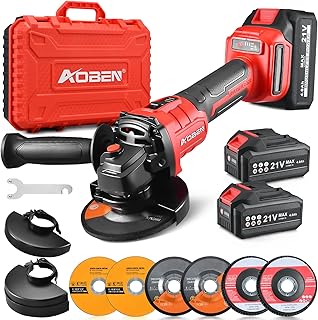
For budget-minded DIYers, the AOBEN Cordless Angle Grinder kit is a great entry point. It includes two 4.0Ah batteries and a brushless motor that runs up to 8,500 RPM. While less powerful than corded models, it’s perfect for light wire brushing tasks away from outlets.
Comparison Table: Best Angle Grinders for Wire Wheels
| Product | Price | Rating | Features | Buy Now |
|---|---|---|---|---|
|
$94.00 | 4.8 | 11 Amp, 11,000 rpm, paddle switch, compact | Buy at Amazon |
|
$69.00 | 4.7 | One-Touch guard, 6 Amp, 11,000 rpm | Buy at Amazon |
|
$62.10 | 4.6 | 7.5 Amp, slim grip, 11,000 rpm | Buy at Amazon |
|
$155.99 | 4.8 | Cordless brushless, Kickback Brake, 9,000 rpm | Buy at Amazon |
|
$58.48 | 4.5 | 21V brushless, 2×4.0Ah batteries, 8,500 rpm | Buy at Amazon |
Choosing the Right Attachment: Wire Wheel vs. Flap Disc vs. Grinding Wheel
It’s important to know when a wire wheel is the right tool. For aggressive material removal, a grinding wheel is faster. For blending and finishing, a flap disc offers a smoother result. Wire wheels shine when you need to clean without removing base material.
Learn more about the differences in our article: Cutting, Grinding, and Flap Discs: What Each Attachment Is Best for.
Bonus: Advanced Wire Wheel Techniques
- Direction of rotation: Always move the wheel from left to right (for a typical side handle configuration) to avoid snagging.
- Angling the brush: A 15–30° angle prevents wire fatigue and increases brush life.
- Lubrication: For heavy rust removal, a light oil spray can reduce heat and wire breakage.
For a complete list of must-have accessories, read Angle Grinder Accessories You Need for Safer, Cleaner, Better Results.
Final Thoughts
Wire wheels are indispensable for surface preparation, but they demand respect. Choose the right brush for your material, match the RPM rating, and use a grinder with modern safety features. Whether you opt for the corded power of the DEWALT DWE402 or the cordless convenience of the AOBEN kit, you’ll be well equipped to tackle rust, paint, and weld cleanup like a pro.
Always pair your wire wheel with the appropriate guard and full personal protective equipment. Stay safe, and let your angle grinder do the heavy lifting.
If you’re still unsure which attachment to use for metal, wood, or masonry, check out our comprehensive guide: Best Angle Grinder Attachments for Metal, Wood, and Masonry.