

Choosing the right portable air compressor for your home projects can feel overwhelming with all the specs flying around. Tank size, PSI, CFM — what do they actually mean for your nail gun or tire inflator? This guide breaks down the three most critical buying factors so you can pick a compressor that matches your DIY workload without wasting money on power you don’t need.
Whether you’re framing a shed, filling car tires, or running a brad nailer, understanding how tank, pressure, and airflow work together is the secret to a happy workshop. Let’s dive into each factor and see how real-world compressors stack up.
Understanding Tank Size: How Much Air Do You Really Need?
The tank size (measured in gallons) determines how much compressed air you can store. A larger tank lets you run tools longer before the motor kicks on to refill. For home projects like stapling trim or inflating sports balls, a 2–6 gallon tank is plenty. If you’re spraying paint or using an impact wrench continuously, aim for 15–29 gallons.
Smaller tanks are lighter and more portable. The DEWALT Pancake Air Compressor, 6 Gallon, 165 PSI (DWFP55126) is a favorite for its balance of capacity and easy carrying. Its pancake shape makes it stable, and the 6-gallon tank handles most finish nailers and inflation tasks without breaking your back.
For jobs that demand more runtime, the Klutch 20-Gallon Air Compressor, 2 HP, 120 Volts, 175 PSI provides a larger reservoir. At $299.99, it’s built for heavier use — think framing nailers or air ratchets. The 20-gallon tank means fewer pauses while the pump refills.
Key point: Match tank size to your typical task duration. Quick inflation? 2–6 gallons. Extended spraying or multiple tools? 15–29 gallons.
The Role of PSI: Pressure That Powers Your Tools
PSI (pounds per square inch) measures the force of the compressed air. Most air tools operate at 90 PSI, but some — like impact wrenches or high-torque nailers — benefit from higher pressure. A higher PSI also means faster refill times and better performance when the tank is near empty.
The ECOMAX Air Compressor 6 Gallon 150 PSI Pancake Portable Oil-free Tank with 10 PCS Accessories Kit delivers 150 PSI — more than enough for all standard DIY tools. With a 4.7-star rating and a full accessory kit, it’s a great entry-level compressor that won’t leave you struggling for pressure.
If you need serious punch, the Klutch 29-Gallon Air Compressor, 2.5 HP, 120 Volts, 175 PSI kicks out 175 PSI. That extra headroom helps when you’re running a high-demand tool like a die grinder or sandblaster. At $329.99, it’s a solid investment for a home garage that doubles as a workshop.
Pro tip: Don’t chase extreme PSI unless your tools specifically require it. 150 PSI is plenty for 95% of home projects.
CFM: The Real Engine of Your Air Compressor
CFM (cubic feet per minute) tells you how much air the compressor can deliver at a given pressure. This is the most overlooked spec. Your tool’s CFM requirement must match or be less than the compressor’s output, or you’ll stall out mid-project. Always check the SCFM (standard CFM) at 90 PSI — that’s the standard benchmark.
For light-duty work (brad nailers, inflators), 2–3 CFM at 90 PSI is fine. For spray guns or impact wrenches, look for 4–6 CFM. The PORTER-CABLE Air Compressor, 6-Gallon, Pancake, Oil-Free (C2002-ECOM) delivers 2.6 SCFM at 90 PSI, which pairs perfectly with a finish nailer. It’s lightweight, well-rated (4.6 stars), and costs $164.
For higher airflow, the VEVOR 13-Gallon Air Compressor, 2HP, 4.6 SCFM@90PSI gives you 4.6 CFM at 90 PSI. That’s enough for most paint sprayers and air tools. Its quiet 66 dB operation is a bonus for indoor use.
Quick rule of thumb: List the tools you plan to use, add up their CFM needs, and choose a compressor that exceeds that number by at least 20%.
Comparison of Top Portable Air Compressors for Home Projects
| Product | Tank | Max PSI | CFM @ 90 PSI | Price | Rating | Buy Now |
|---|---|---|---|---|---|---|
 |
6 gal | 165 PSI | 2.6 SCFM | $204.99 | 4.6 | Buy at Amazon |
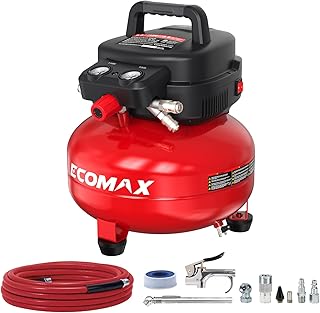 |
6 gal | 150 PSI | 2.4 SCFM | $169.99 | 4.7 | Buy at Amazon |
 |
6 gal | 150 PSI | 2.6 SCFM | $164.00 | 4.6 | Buy at Amazon |
 |
20 gal | 175 PSI | 4.2 SCFM | $299.99 | 4.4 | Buy at Amazon |
Additional Buying Considerations
Beyond the big three specs, think about portability, noise level, and maintenance. Oil-free compressors (like all those listed above) require less upkeep — perfect for weekend warriors. If you work in a shared space, look for units under 70 dB.
For lightweight needs, a cordless tire inflator like the DEWALT Tire Inflator Portable Air Compressor 20V MAX (DCC020IB) is incredibly handy. It’s tool-only, so you need a 20V battery, but it auto-shuts off and has an LED light. Great for on-the-go repairs.
Internal links to related guides will help you fine-tune your choice:
- Best Portable Air Compressors for Home Garage Projects
- What Size Portable Air Compressor Do You Need for DIY Tasks?
- Portable Air Compressors for Tire Inflation vs Nail Guns
- Quiet Portable Air Compressors for Small Workshops
- Lightweight Air Compressors for Easy Carrying and Storage
Final Thoughts
Don’t get lost in the numbers. Tank size gives you runtime, PSI gives you force, and CFM gives you real working power. Prioritize CFM for tools, then match tank size to your project length. A 6-gallon pancake compressor is the sweet spot for most homeowners, while a 20-gallon or larger unit suits serious DIYers.
Check the comparison table above to see how popular models compare. Click any “Buy at Amazon” link to check current prices and read more reviews. With the right tank, PSI, and CFM, you’ll finish your projects faster and with fewer stops. Happy compressing!