

If you’re new to the world of compressed air, you’ve probably heard the term “piston air compressor” more than a few times. It’s the most common type of air compressor used by DIYers, hobbyists, and even professionals in small workshops. But how does it actually work, and what should you look for when buying your first one?
This guide breaks down everything you need to know about piston air compressors, from the basic mechanics to real-world product recommendations. We’ll also compare some of the best beginner-friendly models available on Amazon today.
Before we dive in, it helps to understand the bigger picture. Piston compressors are just one category under the broader umbrella of Air Compressor Types Explained: Piston, Rotary Screw, and More. If you’re looking for a simple, affordable entry point, a piston compressor is usually the right choice.
How Does a Piston Air Compressor Work?
A piston air compressor (also called a reciprocating compressor) uses a motor to drive a piston inside a cylinder. As the piston moves down, it draws air in through an intake valve. When the piston moves up, it compresses that air and forces it into a storage tank.
This cycle repeats rapidly, building up pressure inside the tank. Most piston compressors have a pressure switch that automatically stops the motor once the tank reaches a preset PSI (pounds per square inch) and restarts when pressure drops.
For a deeper look at the core components, read our guide on How an Air Compressor Works: Pump, Motor, and Tank Basics?
Key factors that affect performance include the number of stages (single vs. two-stage) and whether the pump is oil-lubricated or oil-free. If you’re deciding between them, check out our comparison of Single-stage vs Two-stage Air Compressors: Key Differences.
Key Components of a Piston Air Compressor
Every piston compressor shares a handful of essential parts:
- Motor: Provides the power to turn the crankshaft.
- Pump (piston, cylinder, valves): The heart of the compressor that actually compresses the air.
- Tank: Stores compressed air so you don’t need the motor running constantly.
- Pressure switch: Automatically controls when the motor starts and stops.
- Regulator and gauges: Let you adjust and monitor the output pressure.
Most beginner-friendly models also include safety valves, drain valves, and sometimes accessory kits with nozzles, adapters, and inflation needles.
Types of Piston Air Compressors
Not all piston compressors are built the same. Here are the main distinctions:
Single-stage vs. Two-stage
Single-stage compressors are simpler and cheaper, perfect for home use. Two-stage models compress air twice for higher pressure and efficiency, ideal for continuous operation. Learn more in our dedicated guide on Single-stage vs Two-stage Air Compressors.
Portable vs. Stationary
Smaller tanks (2–6 gallons) are lightweight and easy to carry around the job site. Larger tanks (20+ gallons) are heavier but provide longer run times for tools like impact wrenches and spray guns. The choice depends on your workflow. See our take on Portable vs Stationary Air Compressors: Which Type Fits Your Needs?.
Oil-lubricated vs. Oil-free
Oil-free models require less maintenance and are cleaner for painting projects. Lubricated compressors tend to last longer and run quieter, but they need regular oil changes. Most entry-level portable compressors are oil-free.
Common Uses for Piston Air Compressors
Piston compressors are incredibly versatile. Here’s what beginners typically use them for:
- Inflating tires, sports balls, and air mattresses
- Powering nail guns and staplers for woodworking and trim work
- Running air tools like impact wrenches, ratchets, and blow guns
- Spray painting small projects
- Cleaning dust from electronics or workbenches
For tire inflation on the go, consider a dedicated DEWALT Tire Inflator Portable Air Compressor 20V MAX, Car Air Pump with Automatic Shut Off, LED Light, Tool Only (DCC020IB). It’s compact, battery-powered, and rated 4.6 stars with nearly 18,000 reviews.
Another great cordless option is the Airmoto Tire Inflator Portable Air Compressor, which packs a digital gauge and auto shut-off at an affordable price.
Choosing the Right Piston Air Compressor: What to Consider
When you’re shopping for your first compressor, focus on these four factors:
Tank Size
- 2–6 gallons: Best for inflation, brad nailers, and light tasks. Very portable.
- 6–20 gallons: Good for running multiple tools or longer cycles.
- 20+ gallons: Suitable for sanders, grinders, and commercial use.
CFM (Cubic Feet per Minute)
CFM tells you how much air the compressor delivers at a given pressure. Check the CFM rating at 90 PSI — most air tools require 3–5 CFM.
PSI (Maximum Pressure)
Most compressors reach 125–175 PSI. Higher PSI means more reserve capacity for demanding tools.
Noise Level
Some compressors are remarkably quiet (as low as 60–70 dB). If you work in a garage near living spaces, look for “ultra quiet” models.
Best Piston Air Compressors for Beginners: Comparison Table
To help you decide, here are six top-rated models ideal for beginners. Each one is a piston-style compressor with excellent reviews and a beginner-friendly price point.
| Product | Image | Price | Rating | Key Features | Buy at Amazon |
|---|---|---|---|---|---|
| DEWALT Pancake Air Compressor (DWFP55126) |  |
$204.99 | ⭐ 4.6 | 6-gallon, 165 PSI, oil-free, pancake tank, 2.0 SCFM @ 90 PSI | Buy Now |
| PORTER-CABLE Air Compressor (C2002-ECOM) |  |
$164.00 | ⭐ 4.6 | 6-gallon, oil-free, pancake, 2.6 SCFM @ 90 PSI | Buy Now |
| ECOMAX 6-Gallon Pancake | 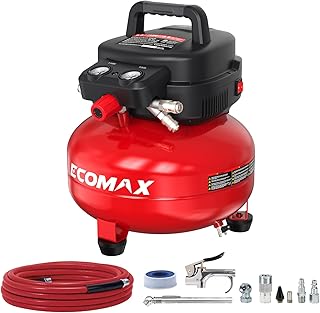 |
$169.99 | ⭐ 4.7 | 6-gallon, 150 PSI, oil-free, includes 10-piece accessory kit | Buy Now |
| CRAFTSMAN 2-Gallon Portable |  |
$149.99 | ⭐ 4.1 | 2-gallon, 1/3 HP, 125 PSI, oil-free, ultra-light with 10-piece kit | Buy Now |
| Klutch 20-Gallon Portable |  |
$299.99 | ⭐ 4.4 | 20-gallon, 2 HP, 175 PSI, portable, no-maintenance operation | Buy Now |
| Klutch 29-Gallon Portable |  |
$329.99 | ⭐ 4.4 | 29-gallon, 2.5 HP, 175 PSI, no-maintenance, ideal for continuous use | Buy Now |
Pro tip: If you mostly need a compressor for home use and light workshop tasks, the ECOMAX Air Compressor 6 Gallon 150 PSI Pancake Portable Oil-free Tank with 10 PCS Accessories Kit offers the best value with a 4.7-star rating and a full accessory set — all under $170.
Maintenance Tips for Piston Air Compressors
Keeping your compressor in good shape is simple. Follow these steps:
- Drain the tank after each use. Moisture builds up inside and can cause rust. Most tanks have a drain valve at the bottom.
- Check the oil level regularly (if you chose an oil-lubricated model). Change it every 3–6 months depending on usage.
- Clean or replace the air filter every few months to maintain airflow.
- Inspect hoses and fittings for leaks or damage.
- Store in a dry, clean area away from dust and debris.
Oil-free models like the DEWALT DWFP55126 eliminate the need for oil changes, making them even more beginner-friendly.
Final Thoughts
Piston air compressors are the workhorses of the DIY world. They’re simple, reliable, and affordable — perfect for anyone just starting out. Whether you’re inflating tires, framing a deck, or detailing your car, there’s a piston compressor that fits your budget and space.
If you need higher air volume for continuous industrial use, you might eventually explore Rotary Screw Air Compressors: How They Work and Where They Shine. But for most beginners, a quality piston compressor from DEWALT, PORTER-CABLE, or Klutch will handle everything you throw at it.
Happy compressing!