

If you’re shopping for an air compressor, you’ve likely heard the term “variable-speed drive” (VSD) tossed around. But what does it actually mean, and why should it matter to your wallet? In short, variable-speed compressors adjust motor speed to match air demand—slashing energy waste and keeping your electricity bill under control. This guide breaks down how VSD technology works, why it’s a game-changer for efficiency, and which models deliver the best value for home shops, garages, and light industrial use.
We’ll also highlight top-rated compressors that bring modern energy-saving features without the premium price tag. Whether you’re running pneumatic tools, inflating tires, or spray painting, understanding variable-speed tech helps you make a smarter, more sustainable purchase. Let’s dive in.
What Is a Variable-Speed Air Compressor?
Traditional air compressors run at a fixed speed. They cycle on and off to maintain pressure, wasting electricity every time they run at full power when demand is low. A variable-speed compressor uses an inverter‑controlled motor that ramps up or down based on real‑time air consumption.
Instead of starting and stopping repeatedly, the motor runs continuously at the precise speed needed. This eliminates wasted run time and reduces wear on components. The result? Up to 35% lower energy consumption compared to fixed-speed units. For buyers focused on long-term savings, VSD is the gold standard in Energy-efficient Air Compressors: What Saves the Most Power?
Benefits of Variable-Speed Technology for Energy Efficiency
- Lower electricity costs – Only the power needed is drawn, no more.
- Quieter operation – Running at partial speed means less noise.
- Extended lifespan – Fewer start/stop cycles reduce motor and pump stress.
- Stable pressure – Consistent CFM output for sensitive tools.
- Reduced peak demand – Helps avoid spikes in industrial electricity billing.
While not all budget-friendly compressors are VSD, many modern oil‑free models incorporate smart controls that mimic some of these benefits. For a deeper look at connected features, read Smart Air Compressor Controls and Their Real-world Benefits.
Key Features to Look for When Buying an Efficient Air Compressor
Whether you choose VSD or a well‑designed fixed‑speed unit, these specs determine real‑world efficiency:
- CFM at your required PSI – Higher CFM at 90 PSI means more usable air.
- Oil‑free pump – Less maintenance and slightly better efficiency.
- Tank size – Larger tanks reduce motor cycling.
- Thermal overload protection – Prevents overheating during extended use.
- Duty cycle – Look for 100% duty cycle for continuous operation.
- Quiet rating – Under 70 dB is excellent for home workshops.
To reduce runtime further, explore How to Reduce Air Compressor Runtime Without Sacrificing Performance?
Top Air Compressors for Energy-Conscious Buyers
We’ve selected six best‑selling compressors that balance efficiency, durability, and price. All are oil‑free for lower maintenance and include features that save power.
1. Klutch 20-Gallon Air Compressor, 2 HP, 120V, 175 PSI

This vertical tank offers 175 PSI maximum pressure and a 2 HP motor designed for sustained use. It includes thermal overload protection and vibration stabilizers. Ideal for framing nailers, impact wrenches, and shop tools. 4.4 stars with hundreds of reviews.
2. Klutch 29-Gallon Air Compressor, 2.5 HP, 120V, 175 PSI

More power and capacity for bigger jobs. The 2.5 HP motor delivers 6+ CFM at 90 PSI, enough to run sanders and paint sprayers. No‑maintenance pump design keeps operating costs low. Perfect for semi‑professional garages.
3. ECOMAX 6-Gallon Pancake Compressor – 150 PSI
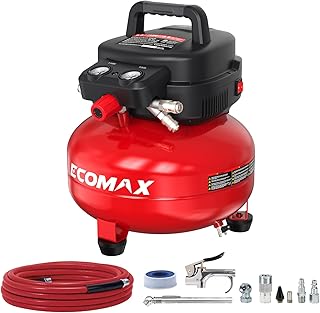
A lightweight, portable option with 4.7 stars from users. The oil‑free pump and 150 PSI rating give you plenty of power for brad nailers and tire inflation. Comes with a 10‑piece accessory kit. Best value for hobbyists.
4. DEWALT Pancake Air Compressor, 6 Gallon, 165 PSI (DWFP55126)

The industry standard. 165 PSI and 2.6 CFM at 90 PSI. High‑efficiency motor reduces power draw. Tough, puncture‑resistant tank and a 4.6‑star rating across 7,000 reviews. Reliable for on‑site use.
5. PORTER-CABLE 6-Gallon Pancake (C2002-ECOM)

Another pancake favorite. 2.6 CFM at 90 PSI, oil‑free pump, and low amp draw (7.5A). High‑flow regulator and couplers improve tool performance. Excellent build quality at a budget‑friendly price.
6. CRAFTSMAN 2-Gallon Portable Air Compressor, 1/3 HP

Ultra‑compact for light duty. 125 PSI and only 20.5 lbs. Oil‑free and includes 10‑piece accessory kit. Great for inflating tires, balls, and running small staplers. One of the most affordable options from a trusted brand.
Comparison Table: Best Energy-Efficient Air Compressors
| Product | Image | Price | Rating | Key Features | Buy at Amazon |
|---|---|---|---|---|---|
| Klutch 20G | |
$299.99 | 4.4 | 2 HP, 175 PSI, vertical tank, thermal overload | Buy Now |
| Klutch 29G | |
$329.99 | 4.4 | 2.5 HP, 175 PSI, 4.5+ CFM @90 PSI, no-maintenance pump | Buy Now |
| ECOMAX 6G | |
$169.99 | 4.7 | Oil-free, 150 PSI, 10-piece kit, lightweight | Buy Now |
| DEWALT Pancake | |
$204.99 | 4.6 | 165 PSI, high-flow design, durable tank | Buy Now |
| PORTER-CABLE 6G | |
$164.00 | 4.6 | Oil-free, 2.6 CFM @90 PSI, low amp draw | Buy Now |
| CRAFTSMAN 2G | |
$149.99 | 4.1 | 1/3 HP, 125 PSI, lightweight, 10-pc kit | Buy Now |
All prices and ratings are accurate as of publication. Click “Buy Now” to check current Amazon listings.
Portable Tire Inflators: Efficiency on the Go
For buyers who need a compact, battery‑powered solution for cars and small jobs, modern tire inflators offer smart auto‑shutoff and digital pressure gauges. Two standout models:
DEWALT 20V MAX Tire Inflator (DCC020IB)
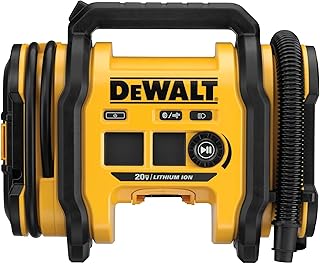
Runs on DEWALT 20V batteries (tool only). Automatic shutoff at preset pressure, LED light, and digital gauge. 4.6 stars from 17,900+ ratings. Best for pros already in the DEWALT ecosystem.
Milwaukee M18 Inflator (2848-20)

4.8 stars – the highest rating in its class. Delivers up to 160 PSI with M18 battery. Also includes auto‑shutoff, digital gauge, and a brushless motor for longer run time. Perfect for demanding on‑site use.
Both models integrate well with IoT Air Compressor Monitoring: Features to Look for when paired with smart battery systems.
VSD vs. Fixed-Speed: Which Should You Choose?
If your work involves varying air demand (e.g., multiple tools running intermittently), a VSD compressor pays for itself within a couple of years through energy savings alone. For steady, full‑load applications like production lines, a high‑quality fixed‑speed unit with efficient motor design may still be cost‑effective.
Newer oil‑free compressors, like the ones listed above, already incorporate many VSD‑inspired efficiencies—better motor insulation, reduced friction, and smart thermal management. Pairing them with a timer or pressure controller further cuts waste.
For a detailed breakdown of drive types, see Electric vs Traditional Compressor Systems: Efficiency Comparison.
Final Buyer’s Checklist
Before hitting “add to cart,” ask yourself:
- What CFM do my tools need at 90 PSI? – Match or exceed the highest demand tool.
- How often will I run the compressor? – Frequent use justifies VSD or larger tank.
- Is portability critical? – Pancake or wheeled vertical tanks suit different spaces.
- Am I willing to invest upfront for long-term savings? – VSD and quality oil‑free pumps save money over 5‑10 years.
Variable-speed air compressors are the future of shop efficiency. Even if your budget leans toward fixed‑speed, choosing a model with smart shutoff, oil‑free operation, and adequate tank size will lower your electricity bills and extend equipment life. The products above deliver proven performance without breaking the bank.
Ready to upgrade? Use the links and table above to compare top‑rated compressors that combine power with energy‑smart features.