

Getting a flawless paint finish starts long before you pick up the spray gun. The real secret is pairing your painter with the right air compressor. Choose a compressor that’s too small, and you’ll fight with pulsing flow and runs in your finish. Too large, and you waste money on capacity you don’t need.
This guide breaks down exactly what CFM, PSI, and tank size you need for spray painting. We’ll also show you the best compressors for the job—from compact pancake units to heavy-duty station models. Let’s match your compressor to your project.
Understanding CFM and PSI for Spray Painting
Two numbers matter most when sizing an air compressor for paint: CFM (cubic feet per minute) and PSI (pounds per square inch). A typical high-volume, low-pressure (HVLP) spray gun requires 4 to 12 CFM at 40 PSI. That’s quite different from what a framing nailer needs.
Most home-use HVLP guns ask for around 6–8 CFM. If you’re using a conventional spray gun, the demand jumps to 10–15 CFM. Always check your gun’s spec sheet—then add 25% to account for line losses and compressor duty cycles.
For deeper insight into how CFM and PSI work together, read our guide on CFM, PSI, and Tank Size: How to Match a Compressor to Your Tools.
Tank Size Matters More Than You Think
A larger tank gives you a buffer. It smooths out the air delivery so you get a consistent spray pattern without waiting for the compressor to kick on mid-pass.
For small touch-ups or airbrushing, a 2‑ to 6‑gallon tank is fine. For painting a door, furniture, or a single panel, go with 6 to 15 gallons. Full-car or kitchen-cabinet jobs demand 20 to 30 gallons or more.
A bigger tank also reduces how often the motor cycles, extending the compressor’s life and keeping noise down—important if you’re working in a residential space.
Oil-Free vs. Oil-Lubricated Compressors
Oil-free compressors are lighter, cheaper, and require less maintenance. They’re perfect for light hobbyist painting. But they tend to run hotter and louder, and they have a shorter lifespan.
Oil-lubricated compressors run cooler and quieter. They last longer and deliver more consistent pressure—critical when you need a glass-smooth paint job. For professional results or frequent use, an oiled pump is worth the extra cost.
Best Air Compressor Options for Spray Painting
We’ve picked a handful of top-rated compressors that deliver the air volume and reliability needed for spray painting. Each is linked to its Amazon page so you can check current prices and reviews.
Klutch 29-Gallon Air Compressor, 2.5 HP, 175 PSI

This beast delivers enough volume for full-day painting sessions. The 29-gallon tank provides ample reserve, and 175 PSI gives you headroom for high-flow guns. It runs on 120V, so it plugs into a standard outlet. Rated 4.4 stars with hundreds of satisfied buyer reviews.
Klutch 20-Gallon Air Compressor, 2 HP, 175 PSI

A slightly more compact sibling at $299.99. Still carries enough tank capacity and pressure for typical automotive or furniture painting. The 2 HP motor keeps CFM high for consistent spraying.
ECOMAX 6-Gallon Pancake Air Compressor (150 PSI)
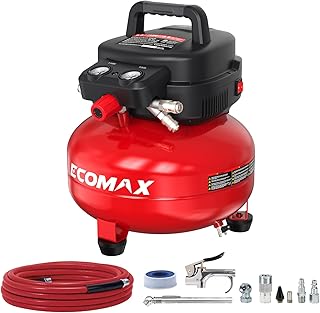
For smaller projects and tight budgets, the ECOMAX is a standout. A 6-gallon tank at 150 PSI with an oil-free pump. It includes a 10-piece accessory kit. With a 4.7 rating and price under $170, this is an excellent starter compressor for hobbyists painting smaller items.
DEWALT Pancake Air Compressor, 6 Gallon, 165 PSI (DWFP55126)

A proven workhorse from a trusted brand. The 6-gallon tank and 165 PSI max pressure give it enough headroom for most HVLP guns used in trim and furniture painting. Extremely portable and reliable. Rated 4.6 stars from over 7,000 reviews.
PORTER-CABLE 6-Gallon Pancake, Oil-Free (C2002-ECOM)

Another solid choice in the 6-gallon pancake category. Lightweight, oil-free, and priced at $164. This unit is a favorite among DIYers and contractors alike. Excellent for small- to medium-sized painting jobs.
VEVOR 13-Gallon Air Compressor, 2HP, 4.6 SCFM@90PSI, Quiet Operation

If noise is a concern, this VEVOR model runs at only 66 dB—quiet enough to hold a conversation nearby. The 13-gallon tank and 2 HP pump are ideal for medium-scale spray painting. The oil-free design means low maintenance.
What About Small Projects or Touch-Up Work?
For light-duty tasks like airbrushing or spot repairs, a smaller compressor can work. The CRAFTSMAN 2-Gallon Portable Air Compressor (1/3HP, 125 PSI) is lightweight and includes a 10-piece accessory kit. It won’t run a full-size HVLP gun continuously, but it’s perfect for smaller detail work.
If you’re exploring other tools like nailers or sandblasters, check our guides on Choosing the Right Compressor for Framing Nailers and What Air Compressor Specs Do You Need for Sandblasting?.
Comparison Table: Best Air Compressors for Spray Painting
| Product | Image | Key Features | Price | Rating | Buy at Amazon |
|---|---|---|---|---|---|
| Klutch 29-Gallon, 2.5 HP, 175 PSI | |
29-gallon tank, 175 PSI, 120V, oil-free | $329.99 | 4.4 | Buy Now |
| Klutch 20-Gallon, 2 HP, 175 PSI | |
20-gallon tank, 175 PSI, 120V, oil-free | $299.99 | 4.4 | Buy Now |
| ECOMAX 6-Gallon Pancake, 150 PSI | |
6-gallon, 150 PSI, oil-free, 10-piece accessory kit | $169.99 | 4.7 | Buy Now |
| DEWALT Pancake 6-Gallon, 165 PSI | |
6-gallon, 165 PSI, oil-free, high-flow regulator | $204.99 | 4.6 | Buy Now |
| PORTER-CABLE 6-Gallon Pancake, Oil-Free | |
6-gallon, 150 PSI, lightweight, oil-free | $164.00 | 4.6 | Buy Now |
| VEVOR 13-Gallon, 2HP, 66 dB Quiet | |
13-gallon, 4.6 SCFM @ 90 PSI, quiet 66 dB, oil-free | $220.90 | 4.5 | Buy Now |
Quick Sizing Reference by Spray Gun Type
- HVLP Touch-up Gun (1.0 mm tip) – 3–5 CFM @ 40 PSI → 6-gallon tank, 150+ PSI works.
- HVLP Production Gun (1.3–1.4 mm tip) – 6–9 CFM @ 40 PSI → 15–20-gallon tank recommended.
- Conventional Full-Size Gun – 10–15 CFM @ 50 PSI → 20+ gallon tank, 175 PSI ideal.
- Airbrush – less than 1 CFM → 2–6-gallon tank is plenty.
For a direct comparison with other tools, see How to Size an Air Compressor for Impact Wrenches?.
Final Tips for a Paint-Ready Air Setup
- Use a moisture trap and regulator – Water in the air ruins paint. A filter at the gun is non-negotiable.
- Keep hoses short and wide – ⅜” or ½” inner diameter reduces pressure drop. A 25-foot ⅜” hose is the sweet spot for painting.
- Check duty cycle – Most home compressors have a 50% duty cycle. If you spray continuously, you need a compressor that can keep up or a larger tank to buffer.
- Always test your setup – Run a straight line on cardboard before your actual project to tune pressure and fan pattern.
Sizing an air compressor for spray painting doesn’t have to be complicated. Match the CFM to your gun, pick a tank that gives you steady air, and choose a unit that fits your workflow. Whether you go with the ECOMAX for weekend projects or the Klutch 29-gallon for production work, the right compressor makes all the difference in a professional-looking finish.