

If you’ve ever watched a construction worker slice through metal or smooth rough concrete, the tool in their hand is likely an angle grinder. These compact power tools are incredibly versatile, but for a beginner, the spinning disc and sparks can seem intimidating. The good news? The basic mechanics are simple to understand. In this guide, you’ll learn exactly how angle grinders work, what the core components do, and which models are worth your money.
We’ll also highlight a few top-rated grinders, starting with the legendary DEWALT Angle Grinder, 4.5 Inch, 11 Amp, 11,000 rpm, With Paddle Switch (DWE402) — a favorite among pros and DIYers alike.
What Is an Angle Grinder?
An angle grinder is a hand-held power tool that uses a rotating abrasive disc to cut, grind, polish, or remove material. The “angle” refers to the right-angle gearbox that transfers the motor’s rotation to the spindle, which holds the disc. This design allows the tool to be held comfortably at a 90-degree angle to the work surface.
Angle grinders are available in corded (electric) and cordless (battery-powered) versions. Most common sizes use a 4‑1/2‑inch disc, though larger models exist for masonry or heavy cutting.
Core Components of an Angle Grinder
To truly understand how an angle grinder works, you need to know its main parts. We’ll break down each component and its role. For a deeper dive into each piece, check out our guide on Angle Grinder Parts Explained: Motor, Spindle, Guard, and Disc.
The Motor
The motor is the heart of the grinder. In a corded model, electricity flows through the trigger to a universal motor that spins at high RPM — typically 8,000 to 12,000 rpm. Cordless models use a brushless DC motor powered by a battery pack. The motor’s power is measured in amps (corded) or volts (cordless). A higher amp rating means more torque and faster material removal.
The Spindle and Arbor
Attached to the motor shaft is the spindle, a threaded rod that extends through the gearbox. The disc is mounted onto the spindle and secured with a lock nut. The arbor is simply the shaft size — most 4‑1/2‑inch grinders use a 5/8‑inch or M14 thread. For more detail, see What Does the Arbor Do on an Angle Grinder?.
The Guard
The guard is a semi-circular metal or plastic shield that covers the rear half of the disc. It protects your hands and face from sparks, debris, and accidental contact. Many guards are tool-free adjustable — you can rotate them to direct sparks away from your body.
Side Handle
Most angle grinders come with a removable side handle that screws into either side of the gear housing. This gives you two‑handed control, which is essential for safety and precision. For a look at ergonomics and vibration features, read Side Handle, Guard, and Anti-vibration Features: What They Do.
The Disc (Wheel)
The disc — or wheel — is the consumable part that does the actual work. There are grinding discs, cutting discs, flap discs, wire brushes, and more. Each is designed for a specific task. The disc is held in place by the spindle nut and a flange.
How Power Turns into Cutting and Grinding
Now that you know the parts, let’s trace the energy path. When you pull the trigger, electricity flows to the motor. The motor spins a shaft connected to a bevel gear set inside the gearbox. Those gears change the direction of rotation from parallel to the motor to perpendicular — that’s what makes the disc spin horizontally.
The spinning spindle transfers high-speed rotation to the disc. For a complete look at this transformation, visit Inside an Angle Grinder: How Power Turns into Cutting and Grinding.
- Grinding uses the disc’s abrasive face to remove material through friction.
- Cutting uses the thin edge of a cutting disc to slice through metal, tile, or stone.
- Polishing uses softer pads to create a smooth finish.
The speed and torque of the motor determine how aggressively the disc bites into the workpiece. A 11‑amp corded grinder like the DEWALT DWE402 gives you sustained power for heavy tasks, while smaller motors may bog down under pressure.
Safety Features You Need to Know
Modern angle grinders incorporate several safety mechanisms. The most critical is the guard, which must always be installed. Many grinders now include paddle switches — you have to keep the paddle pressed to run the tool; releasing it stops the disc instantly. This reduces the risk of accidental startup.
Another important feature is kickback brake or electronic brake. High‑end cordless models like the DEWALT 20V MAX Angle Grinder (DCG413B) stop the disc within seconds of releasing the trigger, preventing dangerous free‑spinning.
Anti‑vibration handles and soft‑start motors also improve control and reduce fatigue. For a complete overview of ergonomics, refer to Angle Grinder Anatomy: a Simple Guide to the Main Components.
Choosing Your First Angle Grinder
When you’re ready to buy, you’ll find dozens of models. The best choice depends on your budget and whether you need portability. Below we compare three excellent options that cover the range.
1. DEWALT DWE402 (Corded)
The gold standard for corded grinders. Its 11‑amp motor delivers 11,000 rpm, and the ergonomic paddle switch offers excellent control. The Dust Ejection System keeps debris out of the switch.
2. Bosch GWS8-45 (Corded)
A lightweight, reliable grinder at a lower price point. The slim grip makes it comfortable for smaller hands, and the 6.0‑amp motor is plenty for general grinding and cutting.
3. DEWALT DCG413B (Cordless)
A brushless cordless grinder with a kickback brake and paddle switch. It’s tool‑only (battery sold separately), but it delivers corded‑like performance. Ideal for job sites without power outlets.
4. AOBEN Cordless Grinder Kit
A budget‑friendly cordless kit that includes two 4.0Ah batteries and a charger. The brushless motor and 21V platform make it a solid starter choice.
Comparison Table
| Product | Image | Price | Rating | Features | Buy at Amazon |
|---|---|---|---|---|---|
| DEWALT DWE402 Corded |  |
$94.00 | 4.8 | 11 Amp, 11,000 rpm, paddle switch, dust ejection | Buy Now |
| Bosch GWS8-45 Corded |  |
$62.10 | 4.6 | 6.0 Amp, 11,000 rpm, slim grip, spindle lock | Buy Now |
| DEWALT DCG413B Cordless |  |
$155.99 | 4.8 | 20V brushless, kickback brake, paddle switch, tool‑only | Buy Now |
| AOBEN Cordless Kit | 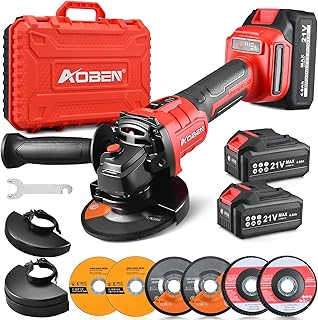 |
$58.48 | 4.5 | 21V brushless, 2×4.0Ah batteries, charger included | Buy Now |
Final Thoughts
Understanding how angle grinders work gives you the confidence to use them safely and effectively. The core principle is simple: an electric motor spins a disc through a right-angle gearbox. But the real magic lies in the components — motor power, guard design, disc selection — that turn that spinning into a capable tool.
For a beginner, start with a corded model like the DEWALT DWE402 for reliability, or go cordless with the AOBEN kit if you need portability. Whichever you choose, always wear safety glasses and gloves, and keep the guard in place.
Ready to learn more? Explore our other guides on angle grinder anatomy, arbor sizes, and safety features to become a real pro.