

If you’ve ever used an angle grinder, you know it’s a powerhouse of versatility. It cuts metal, grinds welds, polishes surfaces, and even removes rust — all with the spin of a disc. But have you ever wondered how that raw electrical energy gets transformed into such aggressive material removal? Let’s open the hood and explore the inner workings of this essential tool.
Understanding how an angle grinder works helps you choose the right model and use it more safely. Whether you’re a DIYer or a pro, the DEWALT Angle Grinder, 4.5 Inch, 11 Amp, 11,000 rpm (DWE402) is a great example of a top-performing corded grinder. But before you buy, let’s see what makes these machines tick.
The Heart of the Machine: The Motor
Every angle grinder relies on an electric motor to generate rotational force. In corded models like the Bosch GWS8-45 4-1/2 In. Angle Grinder, you’ll find a universal motor that runs on AC or DC current. Here’s what happens inside:
- Armature and stator: The stator creates a magnetic field, while the armature (rotor) spins inside it. The interaction of these magnetic fields produces torque.
- Brushes and commutator: Brushes deliver electricity to the spinning commutator, keeping the armature energized. Over time, brushes wear out and need replacement.
- Brushless motors: Higher-end cordless grinders, like the DEWALT 20V MAX Cordless Brushless Angle Grinder (DCG413B), use an electronic controller to eliminate brushes. This increases efficiency, runtime, and motor life.
For a beginner-friendly explanation, check out How Angle Grinders Work: a Beginner-friendly Explanation.
Transmission: From Motor Spindle to Arbor
The motor spins at high RPM — typically 8,000 to 11,000 RPM. But that power needs to be transferred to the disc at a 90-degree angle. This is where the gearbox comes in.
Inside the grinder’s head, a set of bevel gears changes the direction of rotation from the motor axis to the spindle axis. The spindle connects to the arbor, the threaded shaft that holds the disc.
- The arbor size on most 4-1/2-inch grinders is 5/8-11 UNC (unified coarse thread).
- A locking button or pin prevents the spindle from rotating while you change discs.
Want to learn more about this component? Read What Does the Arbor Do on an Angle Grinder?
The Business End: Cutting and Grinding Discs
The disc is where the magic happens. Different materials and jobs require different discs:
Cutting discs are thin and reinforced with fiberglass mesh. They slice through metal, tile, or concrete by abrasion.
Grinding discs are thicker and often made of aluminum oxide or silicon carbide. They remove material by rubbing and smearing.
Flap discs combine grinding and finishing in one, using layered abrasive flaps.
The guard is a critical safety component. It should always be positioned between your body and the disc. Many modern grinders, like the DEWALT DWE4011 with One-Touch Guard, make adjustment tool-free and quick.
For a deeper look at each part, see Angle Grinder Parts Explained: Motor, Spindle, Guard, and Disc.
Power Delivery: Corded vs. Cordless
One of the biggest decisions when buying an angle grinder is whether to go corded or cordless. Each has trade-offs:
Corded Angle Grinders
- Unlimited runtime — just plug in and work.
- Higher power and torque — 6 to 15 amps ensures consistent cutting.
- Lower upfront cost for equivalent power.
- Examples: DEWALT DWE402 (11A), Bosch GWS8-45 (8A), DEWALT DWE402W with Dust Ejection (11A).
Cordless Angle Grinders
- Portability — no cord to drag or outlet needed.
- Brushless motors improve runtime and reduce maintenance.
- Battery voltage matters — 20V/18V is common; higher voltage preserves power.
- Examples: DEWALT DCG413B (20V brushless), AOBEN Cordless Angle Grinder 4-1/2 inch (21V, 2×4.0Ah).
Below is a comparison table of popular models from our selected list:
| Product | Image | Key Features | Price | Rating | Buy at Amazon |
|---|---|---|---|---|---|
| DEWALT DWE402 (Corded, 11A) |  |
11,000 RPM, paddle switch, compact design, dust ejection system | $94.00 | 4.8 | Buy at Amazon |
| DEWALT DWE4011 (Corded, 7.5A) |  |
One-Touch guard, 11,000 RPM, small diameter grip, lightweight | $69.00 | 4.7 | Buy at Amazon |
| Bosch GWS8-45 (Corded, 8A) |  |
11,000 RPM, slim body, 2-position side handle, spindle lock | $62.10 | 4.6 | Buy at Amazon |
| DEWALT DCG413B (Cordless, 20V) |  |
Brushless motor, kickback brake, paddle switch, tool only | $155.99 | 4.8 | Buy at Amazon |
| AOBEN Cordless (21V Kit) | 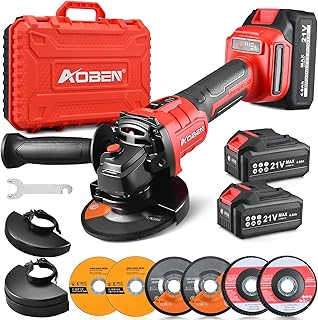 |
Brushless motor, 2×4.0Ah batteries, 8,500 RPM, variable speed | $58.48 | 4.5 | Buy at Amazon |
All these grinders are available on Amazon with fast shipping.
Key Components: Side Handle, Guard, and Safety Features
Beyond the motor and disc, several components make an angle grinder safe and comfortable to use.
- Side handle: Attaches to either side of the gearbox (or top on some models). It gives you two-handed control, reducing fatigue and improving precision. Removable for tight spaces.
- Guard: Adjustable metal shield that deflects sparks and debris. Position it between you and the disc. Tool-less guards like the One-Touch (DEWALT DWE4011) save time.
- Anti-vibration features: Some grinders include dampening rings or cushioned grips. The DEWALT DWE402W has a vibration-dampening side handle.
- Paddle switch vs. slide switch: Paddle switches (like on DWE402) require constant pressure — safer because the grinder stops if you let go. Slide switches lock on for extended use but increase risk.
Learn more about these ergonomic elements in Side Handle, Guard, and Anti-vibration Features: What They Do and get a full overview at Angle Grinder Anatomy: a Simple Guide to the Main Components.
Choosing the Right Angle Grinder for Your Needs
Now that you understand how power turns into cutting and grinding, you can make an informed purchase. Ask yourself:
- Do you need portability? Go cordless with a brushless kit like the AOBEN or DEWALT DCG413B.
- Is runtime critical? Stick with a corded model. The DEWALT DWE402 or Bosch GWS8-45 won’t run out of battery.
- What’s your budget? Entry-level options like the DEWALT DWE4011 ($69) offer excellent value without sacrificing safety.
- Do you prioritize safety features? Look for paddle switch, kickback brake, and tool-less guard.
Whichever you choose, remember that the core technology — motor, gears, arbor, and disc — remains fundamentally the same. The difference lies in the details that affect your comfort, safety, and efficiency.
Final Thoughts
The humble angle grinder is a brilliant example of electromechanical engineering. From the raw power of the motor to the precise bevel gears and the spinning disc, every part works in harmony to transform electricity into controlled abrasion. By understanding the internal components, you’ll not only use your grinder more effectively but also appreciate the craftsmanship behind these tough tools.
Ready to upgrade your toolkit? Explore the models featured above and experience the difference a quality grinder makes.