

Whether you’re cutting rebar or polishing stainless steel, your angle grinder is one of the most versatile power tools in the workshop. But have you ever stopped to think about what makes it spin, stop, or stay safe? Understanding the main components of an angle grinder helps you choose the right tool, use it correctly, and maintain it for years.
In this guide, we’ll break down the anatomy of an angle grinder, from the motor to the guard. We’ll also highlight top-rated models like the DEWALT Angle Grinder, 4.5 Inch, 11 Amp (DWE402) to show how quality components make a difference.
Motor: The Heart That Drives Everything
The motor is the core of every angle grinder. It converts electrical energy into rotational force. In corded grinders, an AC motor delivers high torque and consistent power. In cordless models, a DC brushless motor offers longer runtime and less maintenance.
- Amperage matters. A higher-amp motor (e.g., 11 amps in the DEWALT DWE402) gives you more cutting power for heavy-duty jobs.
- RPM rating typically ranges from 8,000 to 12,000. For grinding, you want 11,000 RPM or more for efficient material removal.
- Brushless motors are now common in premium cordless grinders, like the DEWALT 20V MAX Brushless Angle Grinder (DCG413B). They run cooler and last longer.
For a deeper dive into how power gets turned into cutting action, check out our post on How Angle Grinders Work: a Beginner-friendly Explanation.
Spindle and Arbor: Where the Disc Meets the Machine
The spindle is the threaded shaft that holds the grinding or cutting wheel. The arbor (often the same thread) determines which discs fit your grinder.
- Most angle grinders use a 5/8-inch arbor with 7/8-inch thread (common in North America).
- A spindle lock button lets you lock the spindle while you tighten or loosen the nut with the supplied wrench.
- The flange and lock nut secure the disc. Always check that the disc is centered and tight before powering on.
Understanding the arbor is critical because an incompatible disc can be dangerous. For more, see our guide: What Does the Arbor Do on an Angle Grinder?.
Guard: Your First Line of Defense
The guard is a metal shield that wraps around the disc. It protects your hands, face, and body from sparks, debris, and accidental contact.
- Adjustable guard – allows you to reposition the guard without removing it.
- One-touch or tool-less guard – found on newer models like the DEWALT DWE4011, lets you rotate the guard instantly.
- Dust ejection system – some guards channel dust away from the motor, prolonging tool life.
Never operate an angle grinder without the guard properly installed. It’s not optional.
Side Handle and Anti-Vibration Features
The side handle (or auxiliary handle) gives you a second grip for control and stability. Most grinders accept a handle that screws into either side of the gearbox.
- A rubberized or anti-vibration handle reduces hand fatigue during long jobs.
- Some grinders include a vibration-reducing side handle that absorbs shock, especially useful for grinding.
- The handle position can be changed for left‑ or right‑handed users.
If you want to learn more about handle designs and vibration control, read Side Handle, Guard, and Anti-vibration Features: What They Do.
Switch: Paddle vs. Slide
The switch is how you start and stop the grinder. Two main types exist:
- Paddle switch – a safety lever on the body that you press to run. Release it and the grinder stops. This is the safest option and is found on the DEWALT DWE402 and many pro models.
- Slide switch – a sliding button that locks the grinder ON. You must push it off manually. More convenient for long cuts but less safe if you lose grip.
Some modern cordless grinders also have an electronic brake that stops the disc in seconds.
Gearbox and Bearings: Transferring Power Smoothly
The gearbox houses bevel gears that transfer the motor’s rotation from the axis of the motor to the perpendicular axis of the disc. This is what makes the tool an “angle” grinder.
- Heat dissipation – quality gearboxes use metal alloys and proper grease.
- Bearings – ball bearings support the spindle and armature, reducing friction and extending life.
- A noisy or rough‑running grinder often indicates worn bearings.
Dust and debris can damage the gearbox. Many grinders now include dust ejection systems – like the DEWALT DWE402W – that blow contaminants away from internal components.
Housing and Ergonomics
The housing is typically made of glass‑filled nylon or a composite polymer. It insulates against electrical shock and absorbs impact.
- Ergonomic designs – a slim grip zone, rubber overmold, and balanced weight reduce strain.
- Compact models – like the Metabo HPT G12SR4 – weigh around 4 pounds and fit tight spaces.
- Cordless vs. corded – a cordless grinder gives you freedom but adds battery weight.
Discs and Accessories: The Business End
No angle grinder component list is complete without the discs. Common types include:
- Grinding wheels – for removing material.
- Cut‑off wheels – for slicing metal or tile.
- Flap discs – for blending and finishing.
- Wire brushes – for cleaning rust and paint.
Always match the disc’s maximum RPM to your grinder’s speed. Exceeding it can cause the disc to shatter.
Comparison Table: Top Angle Grinders and Their Anatomy
Here’s how some of the best‑selling models stack up. Click any image or “Buy at Amazon” link to see current prices and ratings.
| Product | Key Components | Price | Rating | Buy at Amazon |
|---|---|---|---|---|
 DEWALT DWE402 DEWALT DWE402 |
11‑Amp motor, 11,000 RPM, paddle switch, dust‑ejection, 5/8‑in arbor | $94.00 | 4.8 | Buy at Amazon |
 DEWALT DWE4011 DEWALT DWE4011 |
One‑touch guard, 6.5‑Amp, compact, 11,000 RPM | $69.00 | 4.7 | Buy at Amazon |
 Bosch GWS8-45 Bosch GWS8-45 |
7.5‑Amp, 11,000 RPM, slim grip, 2‑position side handle | $62.10 | 4.6 | Buy at Amazon |
 DEWALT DCG413B DEWALT DCG413B |
Brushless motor, kickback brake, paddle switch, cordless 20V | $155.99 | 4.8 | Buy at Amazon |
 Metabo HPT G12SR4 Metabo HPT G12SR4 |
6.2‑Amp, 2‑position side handle, includes 5 wheels & case | $59.00 | 4.6 | Buy at Amazon |
 CRAFTSMAN V20 CRAFTSMAN V20 |
Brushless, 20V, compact, paddle switch, tool only | $53.10 | 4.7 | Buy at Amazon |
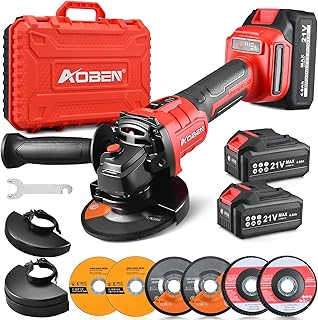 AOBEN Cordless Kit AOBEN Cordless Kit |
Brushless, 21V, 2×4.0Ah battery, 4‑1/2 in, extra accessories | $58.48 | 4.5 | Buy at Amazon |
Prices and ratings are approximate and may change.
Putting It All Together
Every component of an angle grinder works together to turn electricity into safe, controlled cutting or grinding. The motor generates power, the spindle transfers it, the guard protects you, and the switch gives you command.
When shopping for a grinder, focus on:
- Motor amp draw and brushless vs. brushed
- Guard adjustability and dust protection
- Switch type: paddle for safety, slide for convenience
- Side handle comfort and anti‑vibration features
For a complete dissection of what goes on inside the tool, read Angle Grinder Parts Explained: Motor, Spindle, Guard, and Disc.
Final Thoughts
Understanding angle grinder anatomy isn’t just academic – it helps you select a tool that fits your work, maintain it properly, and use it with confidence. Whether you choose a corded workhorse like the DEWALT DWE402 or a cordless performer like the DEWALT DCG413B, knowing what each part does makes you a smarter buyer and a safer operator.
Want to explore further? Check out Inside an Angle Grinder: How Power Turns into Cutting and Grinding.