

Choosing between a portable air compressor and a stationary model can feel overwhelming. You might need something light for quick tire top-ups or a heavy-duty unit to run sanders and spray guns. The right choice depends on your workspace, power requirements, and how often you move the compressor.
In this guide, we break down the key differences, real-world use cases, and top-rated models from brands like Klutch, DEWALT, and ECOMAX. By the end, you’ll know exactly which type fits your needs — and which product delivers the best value.
What Is a Portable Air Compressor?
Portable air compressors are designed for easy transport. They typically feature small tanks (1–6 gallons), lightweight handles, and sometimes wheels. These units are ideal for on-the-go tasks like inflating car tires, running brad nailers, or powering air tools at job sites.
The DEWALT Pancake Air Compressor, 6 Gallon, 165 PSI is a classic example. It weighs only 30 pounds, has a collapsible handle, and delivers enough air for trim work and stapling. Its pancake-shaped tank offers stability without sacrificing portability.
Smaller models like the CRAFTSMAN Air Compressor, 2 Gallon Portable 1/3HP are even more compact. They fit in a trunk and come with a 10-piece accessory kit — perfect for homeowners who need occasional inflation or brad nailing.
Benefits of Portable Compressors
- Lightweight and easy to carry
- Minimal floor space required
- Great for DIY projects and contractors on the move
- Oil-free motors reduce maintenance
- Usually quieter than large stationary units
What Is a Stationary Air Compressor?
Stationary air compressors are built to stay in one place — typically a garage, workshop, or factory. They come with larger tanks (20–80 gallons) and higher horsepower, providing continuous airflow for demanding tools like impact wrenches, sandblasters, and paint sprayers.
The Klutch 20-Gallon Air Compressor, 2 HP, 120 Volts, 175 PSI sits in the sweet spot for home workshops. It offers a vertical tank that saves floor space, stabilizers to prevent tipping, and a high 175 PSI for heavy-duty tasks. At only $299.99, it’s a budget-friendly stationary option.
If you need more capacity, the Klutch 29-Gallon Air Compressor, 2.5 HP, 120 Volts, 175 PSI delivers an extra 9 gallons and a more powerful motor. It’s still portable thanks to wheels, but better suited for stationary use in a fixed location.
Benefits of Stationary Compressors
- Higher CFM ratings for continuous tool operation
- Larger tanks reduce cycling (less wear on motor)
- More durable, often with two-stage pumps
- Can run multiple tools simultaneously
- Better for professional shops and serious DIYers
Key Differences at a Glance
| Feature | Portable Air Compressor | Stationary Air Compressor |
|---|---|---|
| Tank size | 1–6 gallons | 15–80+ gallons |
| Weight | 15–50 lbs | 50–300+ lbs |
| Mobility | Easy to carry, some with wheels | Typically on wheels or bolted down |
| Typical use | Inflation, nailers, small tools | Sandblasting, painting, impact wrenches |
| Duty cycle | Light to medium | Continuous (industrial) |
| Price range | $50–$250 | $250–$1,500+ |
How to Choose: 4 Critical Questions
1. What tools will you run?
If you only need to inflate tires and occasional brad nailing, a portable 2–6 gallon unit like the PORTER-CABLE Air Compressor, 6-Gallon, Pancake, Oil-Free (C2002-ECOM) is sufficient. For running a framing nailer or spray gun, you’ll need a stationary unit with at least 20 gallons and 4+ CFM at 90 PSI.
2. How important is portability?
Contractors moving between job sites need portable compressors. Homeowners with a dedicated garage can choose stationary. The ECOMAX Air Compressor 6 Gallon 150 PSI Pancake Portable is an excellent middle ground — lightweight enough to carry but with enough capacity for trim work.
3. What’s your power source?
Most portable compressors run on standard 120V household outlets. Stationary units can require 240V for motors above 2 HP. The Klutch 20-gallon runs on 120V, making it easy to plug into any garage outlet.
4. Noise level?
If noise is a concern, look for “quiet” or “ultra-quiet” models. Some stationary compressors operate at 66–70 dB, while smaller portables can be louder. Check decibel ratings before buying.
Top Portable Air Compressors Compared
Here are three standout portable models for different budgets and tasks.
1. DEWALT Pancake Air Compressor (DWFP55126)

- Price: $204.99
- Rating: 4.6 (7,000+ reviews)
- Tank: 6 gallon, 165 PSI
- Motor: Oil-free, 1.8 HP running (2.0 peak)
- Weight: 29.7 lbs
- Best for: Framing nailers, roofing, light sanding
This DEWALT is a workhorse for professionals and serious DIYers. Its high 165 PSI provides extra reserve, and the oil-free pump requires no maintenance.
2. ECOMAX 6 Gallon Pancake
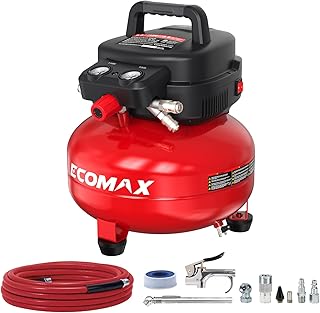
- Price: $169.99
- Rating: 4.7 (242 reviews)
- Tank: 6 gallon, 150 PSI
- Motor: Oil-free
- Accessories: 10-piece kit included
- Best for: Inflation, brad nailers, hobby projects
Best value pick. Comes with everything you need to start: hose, couplers, inflator chuck, and blow gun. Quiet operation and compact design.
3. PORTER-CABLE C2002-ECOM

- Price: $164.00
- Rating: 4.6 (1,400 reviews)
- Tank: 6 gallon, 150 PSI
- Motor: Oil-free, low amp draw
- Weight: 30 lbs
- Best for: Trim work, crown molding, inflating
A trusted name in job-site compressors. Lightweight and reliable with easy-access controls.
Top Stationary Air Compressors Compared
For a fixed workshop setup, larger tanks provide longer run times and higher CFM.
1. Klutch 20-Gallon Air Compressor

- Price: $299.99
- Rating: 4.4 (558 reviews)
- Tank: 20 gallon, 175 PSI
- Motor: 2 HP, 120V, oil-lubricated
- CFM: 5.1 @ 90 PSI
- Best for: Impact wrenches, air ratchets, sanders
Outstanding value for a 20-gallon unit. Vertical tank saves floor space. Includes stabilizers and protection switches.
2. Klutch 29-Gallon Air Compressor

- Price: $329.99
- Rating: 4.4 (558 reviews)
- Tank: 29 gallon, 175 PSI
- Motor: 2.5 HP, 120V, oil-lubricated
- CFM: 6.0 @ 90 PSI
- Best for: Continuous sanding, DA sanders, paint prep
More capacity and power than the 20-gallon. Ideal for a serious home mechanic or woodworker.
3. 15-Gallon Quiet Stationary Compressor (VBESTLIFE)

- Price: $242.99
- Rating: 4.2
- Tank: 15 gallon, 125 PSI
- Motor: 2 HP, 120V, oil-free, 66 dB quiet
- CFM: 4.5 @ 90 PSI
- Best for: Noise-sensitive garages, inflation, nailers
If you hate loud compressors, this is your pick. Runs at 66 dB (conversation level). Twin-cylinder design for quicker recovery.
Comparison Table: Best Portable vs Stationary
| Product | Type | Tank | Max PSI | Motor | Price | Rating | Buy Now |
|---|---|---|---|---|---|---|---|
| DEWALT 6-Gallon |
Portable | 6 gal | 165 | 1.8 HP oil-free | $204.99 | 4.6 | Buy at Amazon |
| ECOMAX 6-Gallon |
Portable | 6 gal | 150 | Oil-free | $169.99 | 4.7 | Buy at Amazon |
| PORTER-CABLE 6-Gallon |
Portable | 6 gal | 150 | Oil-free | $164.00 | 4.6 | Buy at Amazon |
| Klutch 20-Gallon |
Stationary | 20 gal | 175 | 2 HP oil-lubricated | $299.99 | 4.4 | Buy at Amazon |
| Klutch 29-Gallon |
Stationary | 29 gal | 175 | 2.5 HP oil-lubricated | $329.99 | 4.4 | Buy at Amazon |
Which Type Should You Buy?
Choose a portable air compressor if:
- You move between job sites or need to store it in a car
- Your main tasks are inflation, brad nailing, and light stapling
- You have limited garage space
- You prefer no-maintenance oil-free motors
Choose a stationary air compressor if:
- You have a dedicated workshop or garage
- You use high-CFM tools like sanders, grinders, or paint sprayers
- You need longer run times without the motor cycling frequently
- You’re willing to perform periodic oil changes (for lubricated models)
Still unsure? The Klutch 20-Gallon Air Compressor is a fantastic compromise: it has wheels for limited mobility, yet offers stationary-level capacity and pressure. It’s the best bang for your buck under $300.
Final Thoughts
The debate between portable versus stationary air compressors comes down to your specific workshop needs and lifestyle. For most homeowners who occasionally inflate tires and use a nail gun, a 6-gallon pancake compressor like the DEWALT DWFP55126 is more than enough. For dedicated DIYers and professionals who need consistent air volume, a 20- or 29-gallon stationary unit from Klutch offers superior performance.
Remember to always match the compressor’s CFM rating to your highest-demand tool. If you want to dive deeper into compressor technology, check out our related guides: Air Compressor Types Explained: Piston, Rotary Screw, and More, How an Air Compressor Works: Pump, Motor, and Tank Basics?, and Single-stage vs Two-stage Air Compressors: Key Differences.
Your turn: which air compressor will you add to your workshop? Drop a comment below — we’d love to hear about your setup!