

You buy one cordless drill, and suddenly you own six tools, three batteries, two chargers, and a garage full of lime-green (or red, or yellow, or teal) plastic. That’s battery platform lock‑in — the invisible glue that keeps you loyal to a brand long after the initial purchase. Choosing the wrong platform can cost you hundreds of dollars in replacement batteries and chargers down the road. The right choice saves money, reduces clutter, and ensures you always have the power you need.
In this deep dive, we’ll explore what battery platform lock‑in really means, how to evaluate competing ecosystems, and why a portable air compressor or a corded tool still deserves a spot in your workshop. We’ll use real Amazon best‑sellers — from the CRAFTSMAN V20 Tire Inflator (CMCE520B) to the DEWALT 6‑Gallon Pancake Compressor (DWFP55126) — to illustrate the trade‑offs. By the end, you’ll have a clear framework for picking a brand that fits your work style and your budget.
What Is Battery Platform Lock‑In?
Battery platform lock‑in happens when a tool brand uses a proprietary battery shape, voltage, and communication protocol that only works with its own tools and chargers. Once you buy into that system, switching to another brand means replacing not just tools but also the batteries and chargers — often the most expensive part of the setup.
It’s not malicious; it’s a business strategy. Brands want you to stay, so they design batteries that physically fit only their tools and include smart chips that prevent third‑party imitations. The upside for you is tighter integration, better performance, and a growing ecosystem. The downside: if you pick poorly, you’re stuck.
Why It Matters for Your Wallet and Workshop
A single battery costs anywhere from $40 to $150, and a high‑output charger adds another $50–$100. If you own five cordless tools, you likely have three or more batteries. Switching platforms means repurchasing all of that — easily $200–$500 just for power. Worse, old batteries degrade and become harder to find if the brand discontinues the platform.
On the other hand, sticking with one platform allows you to buy “tool only” versions without batteries, saving 30–50% per tool. You also keep one charger type, one storage system, and one set of voltage basics to remember. That’s why Cordless vs Corded Tools: Where Each One Still Wins is a decision you need to make early — and battery platforms are at the heart of it.
The Major Battery Platforms Compared
| Brand | Voltage(s) | Tool Count | Key Strengths | Typical Price (per 5.0 Ah battery) |
|---|---|---|---|---|
| DEWALT | 20V MAX, 60V MAX FlexVolt | 200+ | Rugged, FlexVolt auto‑shifts voltage, wide range of heavy‑duty tools | ~$100–$130 |
| CRAFTSMAN | V20 (20V max) | 150+ | Excellent value, interchangeable with Stanley/Black+Decker? (No – V20 is unique) | ~$50–$70 |
| Milwaukee | M18, M12 | 250+ | Best‑in‑class power, RedLithium technology, huge lineup | ~$110–$150 |
| Makita | 18V LXT, 40V XGT | 200+ | Exceptional runtime, brushless motors, 40V XGT for high‑demand | ~$100–$130 |
| Ryobi | 18V ONE+, 40V | 300+ | Incredible value, tools for every hobby, huge aftermarket | ~$40–$60 |
| PORTER‑CABLE | 20V MAX | 50+ | Budget‑friendly, decent for light‑duty work | ~$50–$70 |
Note: CRAFTSMAN V20 batteries are not cross‑compatible with older Stanley or Black+Decker systems, despite the same parent company. Always verify.
What the Table Tells You
- Higher voltage (e.g., DEWALT 60V FlexVolt) gives more power for circular saws and grinders but adds weight.
- Tool count matters only if you actually need those tools. Ryobi’s 300+ includes many niche items (hot glue guns, soldering irons) that a pro may never use.
- Price per battery is critical because you’ll buy multiple. CRAFTSMAN and Ryobi offer the best value for homeowners.
How to Evaluate a Battery Platform
Before you buy your first cordless tool, run through this checklist:
1. Tool Selection
List the tools you plan to buy over the next 2–3 years. Must‑haves for most workshops: drill/driver, impact driver, circular saw, reciprocating saw, angle grinder, and a tire inflator. Check that the brand offers each in a brushless model (better runtime, longer life). For example, the DEWALT Tire Inflator 20V MAX (DCC020IB) is a top‑rated cordless inflator with 4.6 stars and automatic shut‑off — a perfect companion to a DEWALT drill set.
2. Battery Compatibility
Does the brand use one battery for all its tools within a voltage class? DEWALT’s 20V MAX batteries work with every 20V tool, and FlexVolt batteries automatically switch between 20V and 60V. CRAFTSMAN V20 batteries are also universal across their V20 line. Avoid brands that have multiple incompatible battery families (e.g., some older models).
3. Power and Runtime
Look at amp‑hour (Ah) ratings. Higher Ah = longer runtime but heavier. A 5.0 Ah battery is a good all‑rounder. Check if the brand offers “High Output” or “XP” batteries that deliver more current for high‑demand tools. For light inflator use, even a 2.0 Ah battery works fine — the CRAFTSMAN V20 Air Compressor Portable (CMCE521B) is a tool‑only inflator at $39 that runs on any V20 battery.
4. Price per Tool + Battery
Calculate the total cost of ownership. Suppose you want a drill, impact driver, circular saw, and inflator. With CRAFTSMAN V20, you might spend $200–$300 for tools (bare) plus $80 for two batteries. With DEWALT, the same four tools could cost $400–$500 plus $150 for batteries. The extra investment buys better durability and a wider pro‑grade lineup.
5. Warranty and Innovation
Most brands offer 3‑year warranties on tools and 1–2 years on batteries. Some (like Milwaukee) have a 5‑year tool warranty. Also consider the brand’s track record for releasing new tools. DEWALT and Milwaukee regularly refresh their lines; CRAFTSMAN has been slower but recently added brushless options.
6. Future‑Proofing
Avoid platforms that are being phased out. For example, DEWALT’s older 18V Ni‑Cd system is dead. Stick with current‑gen lithium‑ion platforms. If you’re on a tight budget, Ryobi ONE+ has been around for over 20 years and shows no sign of disappearing.
Real‑World Examples: Cordless Inflators
Cordless tire inflators are a great way to test a platform without a huge investment. They’re handheld, cheap, and use the same batteries as your drills. Let’s look at two popular options:
DEWALT DCC020IB (Tool Only)
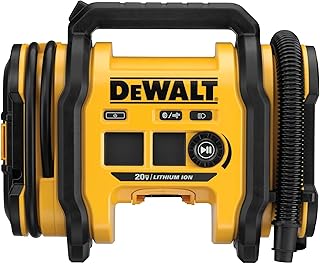
- Price: $130.22
- Rating: 4.6/5
- Key features: Automatic shut‑off, digital gauge, LED light, bare tool (battery not included)
- Pros: Extremely durable, accurate shut‑off, fast inflation (up to 160 psi)
- Cons: Higher price, big and heavy for an inflator
CRAFTSMAN V20 CMCE520B (Tool Only)
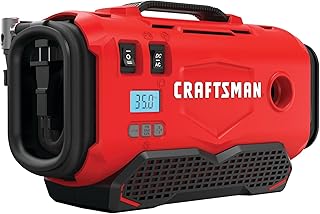
- Price: $49.00
- Rating: 4.4/5
- Key features: 3‑mode power (cordless, 120V corded, 12V car adapter), digital gauge, automatic shut‑off
- Pros: Versatile power options, very affordable, compact
- Cons: Plastic build feels less rugged, slower than DEWALT
Which Should You Pick?
- If you already own DEWALT 20V tools, the DCC020IB is a no‑brainer — one battery fits all.
- If you’re starting fresh or already in the CRAFTSMAN V20 ecosystem, the CMCE520B at $49 is unbeatable value. Its 3‑mode design also works as a backup if your batteries die.
- For sheer budget savings, the CRAFTSMAN V20 CMCE521B at $39 is even cheaper (inflator only, no corded option).
Don’t Forget Air Compressors: An Alternative Power Source
Battery platforms are convenient, but they have limits. For heavy‑duty tasks like running a framing nailer, impact wrench, or sandblaster, cordless batteries drain quickly and cost a fortune to buy multiple high‑Ah packs. That’s where an air compressor shines.
An air compressor uses a tank to store compressed air, delivering consistent power for continuous tool use. You can run a nail gun all day on a 6‑gallon tank, while a battery‑powered nailer might need a new battery every 200 nails. Plus, air tools are often lighter and cheaper than their cordless counterparts.
The PORTER‑CABLE C2002-ECOM is a classic 6‑gallon pancake compressor (4.6 stars, $164). It’s oil‑free, portable, and perfect for brad nailers and staplers. Similarly, the DEWALT DWFP55126 offers 165 psi max, making it one of the strongest pancake compressors on the market.
For smaller jobs — inflating tires, blowing dust, running a pin nailer — a compact model like the CRAFTSMAN 2‑Gallon Air Compressor (B0DLKSR6LD) at $129.99 is enough. It’s light, quiet, and comes with a 10‑piece accessory kit.
Oil‑Free vs Oil‑Lubricated
- Oil‑free (most pancake compressors): Lower maintenance, no oil changes, but louder and shorter pump life.
- Oil‑lubricated (belt‑drive units): Quieter, longer life, but need periodic oil changes and are heavier.
For a home garage, oil‑free is usually the right pick. If you run the compressor every day, consider one with an oil pump. Read our guide: Oil‑Free vs Oil‑Lubricated Air Compressors: Which One Fits Your Workshop.
The Best Air Compressors to Complement Your Battery Platform
You don’t have to choose one or the other. Many workshops combine a cordless platform for mobility and an air compressor for heavy lifting. Here are four top‑rated compressors from the real data:
| Model | Tank Size | Max PSI | Rating | Price | Best For |
|---|---|---|---|---|---|
| CRAFTSMAN 2‑Gal (B0DLKSR6LD) | 2 gal | 125 | 4.0 | $129.99 | Inflation, light stapling, dusting |
| ECOMAX 6‑Gal (B0D7322DB2) | 6 gal | 150 | 4.7 | $169.99 | Framing nailer, impact wrench (small) |
| PORTER‑CABLE C2002‑ECOM (B09BXYP2R9) | 6 gal | 150 | 4.6 | $164.00 | Brad nailer, stapler, general shop |
| DEWALT DWFP55126 (B00K34UZBW) | 6 gal | 165 | 4.6 | $204.99 | High‑demand nailers, high PSI tools |
The ECOMAX 6‑Gallon is a standout at 4.7 stars — it’s quiet, oil‑free, and includes a 10‑piece accessory kit. It rivals the DEWALT in performance at a lower price. For portability, the CRAFTSMAN 2‑gallon unit is hard to beat for under $130.
Accessories That Work Across Platforms
One advantage of air compressors: they use standard 1/4″ NPT couplers, so accessories are brand‑agnostic. The JASTIND Industrial Air Blow Gun ($11.99, 4.6 stars) has a brass adjustable nozzle and steel extensions — perfect for cleaning sawdust. The High Volume Powerful Industrial Air Blow Gun ($12.99, 4.6 stars) extends from 17″ to 26″ and swivels 360°.
For a complete air tool kit, the DYNAMIC POWER 50‑Piece Set (D-W3-50K) ($99.99, 4.4 stars) includes an impact wrench, ratchet, air hammer with chisels, and more. It’s an excellent starter kit for anyone who already owns an air compressor.
Battery platform lock‑in doesn’t apply to these accessories — they work with any compressor. That’s a hidden benefit of keeping a corded/pneumatic setup in your shop.
Making the Right Choice for Your Workshop
Here’s a practical decision tree:
- I need ultimate mobility and don’t mind buying multiple batteries. → Go all‑in on a single battery platform. DEWALT for pros, CRAFTSMAN or Ryobi for homeowners.
- I do framing, roofing, or auto work that demands high air volume. → Buy a 6‑gallon pancake compressor (ECOMAX or DEWALT) and a set of air tools. Add a cordless inflator for portability.
- I have a mixed workshop (woodworking + automotive). → Choose a battery platform for drills, impact drivers, and a circular saw. Then invest in a quiet compressor for staplers and air hammers.
- I want the lowest possible upfront cost. → Start with a CRAFTSMAN V20 inflator and a CRAFTSMAN 2‑gallon compressor. Total: under $180 for both power sources.
No matter which path you choose, always plan for the future. Every battery you buy locks you in a little more. And every air compressor purchase frees you from that lock‑in for high‑power tasks.
Final Thoughts
Battery platform lock‑in is a fact of modern power tools. You can’t avoid it, but you can outsmart it. Pick a brand with a wide tool lineup, reasonable battery prices, and a history of backward compatibility. Then complement that platform with an air compressor for the jobs that batteries struggle with.
The best workshop isn’t all yellow, all red, or all green — it’s a smart mix of cordless freedom and pneumatic muscle. Start with a solid battery ecosystem, add a quality compressor, and you’ll never be locked into a single tool again.
For more guidance, check out: