

A circular saw is one of the most versatile power tools in any workshop. It can rip plywood, crosscut dimensional lumber, and even handle sheet goods with precision — but only if you know how to guide it straight. Poor technique leads to wavy cuts, binding blades, and wasted materials. The difference between a pro-grade finish and a rough edge often comes down to setup, body mechanics, and the right accessories.
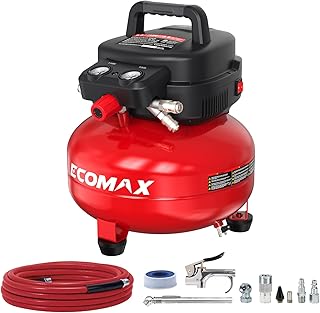
If you’re serious about building furniture, installing flooring, or framing walls, mastering straight cuts with a circular saw is non-negotiable. This guide covers every aspect: from blade selection and measuring to using guide systems and maintaining your tool. And because a clean workshop runs on more than just sawdust, we’ll also show how a quality air compressor keeps your saw and workspace ready for the next cut. Check out the ECOMAX Air Compressor 6 Gallon 150 PSI Pancake for a reliable workhorse that powers cleanup and pneumatic accessories.
Why Straight Cuts Matter More Than You Think
A straight cut isn’t just about appearance. It affects how joints fit, how panels align, and even how safe the saw operates. When a blade wanders, it can bind, kick back, or overheat. On the job site, a crooked cut means rework and material waste. At home, it turns a weekend project into a frustration.
The beauty of a circular saw is its ability to make long, continuous cuts that a table saw cannot handle — think full sheets of plywood or long planks. But with no fence or miter gauge built in, the operator becomes the guide. That’s why technique matters.
Choosing the Right Circular Saw for Straight Work
Before you even make a cut, the tool itself must be capable. Look for these features:
- Motor power: 15 amps is standard for most corded saws. More power means less blade stall.
- Base plate flatness: A warped shoe leads to uneven cuts. Check for cast aluminum or stamped steel that sits true.
- Bevel adjustments: For straight cuts, you want a saw that locks firmly at 0° with no play.
- Sightlines: A clear line-of-cut indicator (notch or laser) helps you track the mark.
Corded vs Cordless
Corded saws offer consistent speed and torque — ideal for long rip cuts. Cordless models give mobility but require high-voltage batteries (60V or 36V) to maintain blade speed under load. If you’re cutting multiple sheets, a corded saw is still the reliable choice.
Blade Selection: The Hidden Variable
A dull or wrong blade is the #1 cause of wandering cuts. Use this table to choose:
| Blade Type | Tooth Count | Best For |
|---|---|---|
| Framing / Rip | 24 teeth | Fast cuts along the grain (2x4s, studs) |
| General Purpose | 40 teeth | Crosscuts and sheet goods |
| Fine Finish | 60–80 teeth | Veneered plywood, melamine, trim |
| Thin Kerf | Varies | Less power required, but more prone to deflection |
Always match the blade to the material. A fine-finish blade on a 2×4 will burn and bog down. A rip blade on plywood will chip the face. And regardless of tooth count, keep blades sharp — a dull blade pulls sideways and drifts off the line.
Setting Up for Success: Safety, Workspace, and Material Support
Straight cuts start before the saw touches the wood.
Safety First
- Wear eye and hearing protection. Kickback can happen in an instant.
- Secure the material — never cut while holding a piece with one hand and the saw with the other. Use clamps or a non-slip mat.
- Keep the cord (or battery pack) out of the cut path. Dragging it through the blade is dangerous.
- Inspect the blade guard: it must retract and snap back freely.
Work Surface
You need a flat, stable platform that supports both sides of the cut. Sawhorses with a plank work for short pieces, but for full sheets, use a sheet-good cutting table or rigid foam insulation panels laid on a flat floor. The material should not bend or sag; if it does, the kerf will close on the blade and cause binding.
Material Positioning
For most straight cuts, place the good side down if using a standard circular saw (blade cuts upward). The top face will have slight tear-out from the blade exit. If you need a clean finish on the top, use a zero-clearance base or a track saw.
Marking and Measuring: The Foundation of Straight Cuts
A saw can only cut where you point it. Accurate layout is half the battle.
- Use a sharp pencil or marking knife. A thick line leaves too much room for error.
- For long cuts, snap a chalk line or use a straightedge to draw the line.
- Mark the waste side of the line so you know which side to cut. This removes guesswork when aligning the blade.
- For repeated cuts, set up a stop block or tape measure with a hook. Don’t rely on “eyeballing” length.
The “Cut on the Line” Rule
Align the blade’s kerf (cut width) so that it removes the pencil mark, leaving the good piece exactly to the line. If you cut exactly on the line, you’ll lose about 1/8 inch (depending on blade kerf). Practice on scrap until you can consistently split the line.
Using a Guide System: The Secret to Laser-Straight Cuts
Even expert woodworkers use a guide. The human hand cannot hold a saw perfectly straight for six feet. Here are the most effective systems.
Clamped Straightedge
The simplest and most affordable method. Clamp a long level, aluminum ruler, or factory-cut plywood strip parallel to your cut line.
- Measure from the saw’s base edge to the blade set at full depth. This distance (typically 1½ to 2 inches) is your offset.
- Clamp the straightedge that exact distance from the cut line (on the waste side).
- Run the saw’s base against the straightedge while cutting.
Pro tip: use a scrap piece first to confirm the offset and adjust clamps. Then make the final cut.
Track or Guide Rail Systems
Track saws like Festool or DeWalt are purpose-built for this. But you can also buy universal track adapters for standard circular saws. The rail has a rubber strip that grips the work and a channel for the saw’s base to ride in. The result is zero deflection — even on 8-foot cuts.
Homemade Zero-Clearance Guide
Attach a thin strip of hardboard to the bottom of the saw’s base. Run a cut through it while the saw is off (or carefully with a pre-installed blade). This creates a perfect slot that shows exactly where the blade will go. Then clamp a straightedge to the slot for ultra-precise alignment.
Technique: Body Position, Speed, and Pressure
Even with a guide, how you handle the saw matters.
Stance and Grip
- Stand to the side of the cut line, not directly behind the saw. This keeps you clear of kickback.
- Use a firm two-handed grip: one hand on the main handle (trigger hand), the other on the front auxiliary handle or on the base plate — never directly in front of the blade path.
- Keep your arms relaxed but in control. Tension causes micro-adjustments that throw the saw off.
Starting the Cut
- Let the blade reach full speed before it touches the wood. Starting under load strains the motor and can cause the blade to grab.
- Lower the blade slowly into the material. Do not drop the saw onto the cut.
- Keep the base plate flat against the workpiece. Tilting the saw will create a bevel, not a straight perpendicular cut.
Pacing the Cut
- Push, don’t pull. The saw rotates forward; let the teeth do the work. Forcing it slows the blade and can cause burning.
- Maintain a steady feed rate. If you hear the motor struggling, ease off. If the blade zips through too fast, it may chip the edge.
- For long rip cuts, take breaks if your arms fatigue. A tired grip leads to wandering.
Throughout the Cut
Keep your eyes on the guide, not on the blade. Look where you want the saw to go — at the end of the cut or along the straightedge. Your body naturally follows your gaze. Also, check the saw’s line-of-cut indicator from time to time, but don’t fixate on the blade.
Nearing the End
As the blade exits the wood, be prepared for the offcut to drop or shift. Support the waste piece so it doesn’t pinch the blade. A sudden bind at the end can cause kickback. Ease off pressure just before the cut finishes.
Common Mistakes and How to Avoid Them
Even experienced DIYers slip up. Here are the top errors that ruin straight cuts.
Not Supporting the Workpiece
The most common cause of binding. If the offcut falls away unsupported, it pinches the blade. Always support both sides of the cut with stands, rollers, or a helper.
Cutting on the Wrong Side of the Line
It’s easy to mark a line and then cut on the “keep” side by accident. Always double-check: the blade thickness removes the line, so the piece you want should be untouched. Use a pencil X on the waste side.
Using the Wrong Blade Depth
Too deep and the blade exposes more teeth than needed, increasing friction and the chance of binding. Too shallow and the saw may not cut through. Set depth so the blade extends about ¼ inch below the material.
Rushing the Cut
Speed is the enemy of accuracy. A 4-foot cut should take 10–15 seconds with a circular saw. If you’re finishing in five seconds, you’re pushing too hard and likely drifting.
Ignoring the Cord or Hose
A compressed air hose (if using pneumatics) or power cord can snag on the workpiece and pull the saw off line. Secure the cord over your shoulder or use a retractable reel.
Maintenance and Blade Care
Your circular saw will only cut straight if its components are in good shape.
- Clean the base plate regularly. Resin and dirt cause the saw to glide unevenly.
- Check the set screws that secure the base to the saw body. Loose screws allow the plate to shift, changing alignment.
- Replace blades when they become dull. A burnt smell, rough cuts, or visible chipping means it’s time.
- Lubricate the arbor if your saw has a spindle lock. A little oil prevents binding.
Blade sharpening: You can sharpen carbide-tipped blades at home with a diamond file, but for best results, send them to a professional service. A sharp blade cuts straight; a dull one wanders.
Integrating Compressed Air in Your Workshop
Air compressors might seem unrelated to a circular saw, but they play a vital role in keeping your workspace efficient and safe. After every few cuts, sawdust builds up on the workpiece and guide rail. That dust can lift the saw’s base slightly, skewing the cut. A quick blast from an air blow gun clears the debris instantly.
Also, pneumatic nailers are often used to secure workpieces or temporary fences before cutting. A small pancake compressor like the DEWALT Pancake Air Compressor, 6 Gallon, 165 PSI (DWFP55126) can run a finish nailer and a blow gun simultaneously — perfect for a sheet-good cutting station.

For cleaning fine dust off your saw’s base plate between cuts, a long-reach blow gun is ideal. The JASTIND Industrial Air Blow Gun with brass nozzle allows precise airflow without damaging tools.
When choosing a compressor for your workshop, consider factors like tank size, portability, and noise. For a detailed guide, read How to Choose the Right Air Compressor Size for a Home Garage. You’ll learn how to match PSI and CFM to your tools.
Recommended Compressors for Your Workshop
Not all compressors are created equal. For a workshop that includes a circular saw station, you want reliability and quick recovery time. Here are top picks from the data:
| Model | Tank Size | Max PSI | Rating | Best For |
|---|---|---|---|---|
| DEWALT DWFP55126 | 6 Gal | 165 | 4.6 | Heavy-duty nailing & blow-off |
| PORTER-CABLE C2002-ECOM | 6 Gal | 150 | 4.6 | Oil-free, quiet operation |
| ECOMAX 6 Gal | 6 Gal | 150 | 4.7 | Budget-friendly, includes accessories |
| CRAFTSMAN 2 Gal | 2 Gal | 125 | 4.0 | Portable, light trim work |
For finishing tasks around your saw setup, cordless inflators like the DEWALT DCC020IB offer portable air without a hose. However, for continuous blow-off and nailing, a pancake or hot dog compressor is more practical. Learn more about tank styles in Pancake, Hot Dog, and Twin Stack Compressors Explained.
Advanced Tips for Ultra-Straight Cuts
Once you’ve mastered the basics, push your skills further.
Scoring the Cut Line
For plywood or melamine, run a utility knife along the cut line before sawing. This cuts the top veneer and prevents tear-out. The saw then follows this score line, producing a razor-sharp edge.
Using a Zero-Clearance Insert (for saws with a removable base)
Some circular saws allow you to attach a sacrificial base. After running the saw through, you have a perfect slot that eliminates chip-out and helps guide the saw precisely.
Making Plunge Cuts
For pocket cuts (starting in the middle of a panel), retract the blade guard, set the depth, and slowly lower the spinning blade into the material. Practice on scrap first — it’s easy to let the saw jump.
Cut Three Times, Measure Once
For critical workpieces, cut slightly oversize first (about 1/8 inch), then trim to the final line. This removes any initial drift and gives you a perfect edge.
Common Questions About Straight Cuts
Q: Do I need a track saw to get straight cuts?
No. A clamped straightedge with a standard circular saw works just as well. A track saw is faster and more convenient, but technique matters more than gear.
Q: Why does my saw drift even with a guide?
Check that the guide is clamped securely and the saw’s base is flat. Also verify the blade is square to the base. Use a combination square against the blade and base.
Q: How do I stop plywood from chipping?
Place the good side down, use a fine-tooth blade (60–80 teeth), and score the line first. You can also apply blue painter’s tape along the cut line.
Q: Can I use a circular saw without a guide?
For short cuts (less than 2 feet) on dimensional lumber, experienced users can cut freehand by focusing on the marker. But for any length over 24 inches, use a guide.
Conclusion
Using a circular saw for straight cuts isn’t a mystery — it’s a series of deliberate choices. Select the right blade, support your material, mark accurately, and guide the saw with a straightedge or track. Then practice the smooth, steady push that keeps the blade from wandering. Over time, you’ll build muscle memory that makes straight cuts feel automatic.
Don’t overlook your workshop environment. A clean workspace and a reliable air compressor ensure your saw stays dust-free and your cut lines remain visible. Keep your tools maintained, your blades sharp, and your focus on the end goal.
For more on building a complete workshop, read Setting Up Your First Workshop: Tools Every Beginner Needs and Cordless vs Corded Tools: Where Each One Still Wins. And if you’re dealing with compressed air issues, see Common Air Compressor Problems and How to Fix Them Yourself.
Now, set up your saw, grab a straightedge, and start cutting like a pro.