

Choosing between a corded and a cordless angle grinder can be tough. Both offer serious cutting, grinding, and polishing power, but each has distinct strengths depending on your workspace and project demands.
In this guide, we’ll break down the real-world differences so you can decide with confidence. Whether you’re a weekend DIYer or a full-time tradesperson, understanding corded vs cordless angle grinders will save you time, money, and frustration.
What Are the Core Differences?
Angle grinders come in two main power sources: corded (electric) and cordless (battery-powered). The choice often comes down to portability versus constant power.
Corded grinders plug into a wall outlet. They deliver consistent, high-torque performance without worrying about battery life. Cordless grinders run on rechargeable batteries, giving you freedom of movement and the ability to work in remote locations.
Think of corded as “never run out of juice,” and cordless as “take it anywhere.” But there’s more nuance to consider.
Corded Angle Grinders: The Pros and Cons
Advantages of Corded Models
Corded grinders offer unlimited runtime as long as you have power. This makes them ideal for heavy-duty tasks like cutting through thick metal, grinding welds, or removing mortar.
They also tend to be more powerful at a lower price point. For example, the DEWALT Angle Grinder, 4.5 Inch, 11 Amp, 11,000 rpm (DWE402) delivers robust 11-amp performance for under $100. You get the grunt you need without the higher cost of battery systems.
Additionally, corded units are generally lighter than cordless models with batteries attached. Less weight means less fatigue during extended use.
Disadvantages of Corded Models
The biggest downside is limited mobility. You’re tethered to a power outlet, which can be frustrating on job sites with no nearby power or when working in a driveway far from the garage.
Cord management is another hassle. Cords can get tangled, snagged, or damaged by abrasive dust and sharp debris.
Cordless Angle Grinders: The Pros and Cons
Advantages of Cordless Models
Portability is the #1 reason to go cordless. You can take the grinder up a ladder, into a crawl space, or out to a fence line without hauling a generator.
Modern lithium-ion batteries—like those in the DEWALT 20V MAX Cordless Brushless Angle Grinder (DCG413B)—provide ample run time for most tasks. Brushless motors also improve efficiency and extend battery life.
Cordless grinders are safer in certain situations because there’s no cord to trip over or cut through by accident.
Disadvantages of Cordless Models
The main trade-off is limited runtime and power. Heavy grinding drains a battery quickly, and you may need multiple batteries for all-day work.
Cordless models are also more expensive once you factor in the cost of batteries and chargers. For instance, the DCG413B is tool-only at $155.99; adding a battery and charger pushes the cost higher.
Weight is another factor. Batteries add bulk, making the tool top-heavy and more fatiguing over long sessions.
Key Factors to Compare Before Buying
When deciding between corded and cordless, consider these five factors:
1. Power and Performance
Corded grinders typically range from 6 to 15 amps. The higher the amperage, the more torque you get for tough cuts. Cordless models are rated by voltage (18V, 20V, 36V) and motor type. Brushless motors deliver better performance and run time.
2. Runtime vs. Continuous Use
If you’re cutting rebar all day, a corded grinder is the smarter choice. For quick, intermittent jobs—like cutting a few bolts or grinding a weld—cordless works great.
3. Portability and Worksite Conditions
Working in tight spaces or outdoors? Go cordless. In a workshop with outlets nearby? Go corded.
4. Cost of Ownership
Corded grinders are usually cheaper upfront. Cordless requires an initial investment in batteries, but if you already own the same battery platform, the cost drops.
5. Safety and Ergonomics
Cordless eliminates tripping hazards. Corded models often feature paddle switches (like the DWE402) that offer better control and safety. Look for features like kickback brake and electronic brake on modern models.
Top Corded and Cordless Models Compared
To help you decide, here’s a side-by-side look at some of the best-rated angle grinders from both categories. Each product is linked to its Amazon page for easy purchase.
Product Comparison Table
| Product | Image | Price | Rating | Key Features | Buy at Amazon |
|---|---|---|---|---|---|
| DEWALT DWE402 Corded 4.5″ 11A |  |
$94.00 | ⭐ 4.8 | 11 Amp motor, 11,000 rpm, paddle switch, ergonomic compact design | Buy Now |
| DEWALT DWE4011 Corded 4.5″ |  |
$69.00 | ⭐ 4.7 | One-Touch guard, 6.5 Amp, compact and lightweight | Buy Now |
| Bosch GWS8-45 Corded 4.5″ |  |
$62.10 | ⭐ 4.6 | 6.0 Amp, 11,000 rpm, slim grip, durable | Buy Now |
| DEWALT DCG413B Cordless 20V Brushless |  |
$155.99 | ⭐ 4.8 | Brushless motor, kickback brake, paddle switch, tool only | Buy Now |
| AOBEN Cordless 4.5″ 21V Kit | 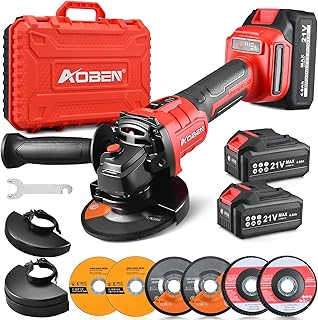 |
$58.48 | ⭐ 4.5 | Brushless motor, 2×4.0Ah batteries, charger included | Buy Now |
| Metabo HPT G12SR4 Corded 4.5″ |  |
$59.00 | ⭐ 4.6 | 6.2 Amp, 5 grinding wheels, hard case included | Buy Now |
Which One Should You Choose?
Choose Corded If:
- You work in a workshop, garage, or any space with easy access to outlets.
- You need sustained power for heavy-duty grinding or cutting all day.
- You want the best value per watt—corded grinders offer more power for less money.
- You dislike dealing with battery chargers and spare batteries.
Choose Cordless If:
- You frequently work on job sites without power or in remote locations.
- You need a compact, portable tool for quick cuts and light grinding.
- You already own a battery platform (like DEWALT 20V MAX) and can share batteries.
- You value safety and convenience—no cords to trip over or snag.
For a deeper dive into motor type, check out our guide on Brushless Angle Grinders Explained: Are They Worth It?. Understanding brushless technology will help you choose a cordless model that lasts.
Final Verdict
There’s no universal winner. The best angle grinder depends entirely on your specific needs. For stationary, high-demand work, a corded model like the DEWALT DWE402 gives you unbeatable torque and value. For flexibility and mobility, the DEWALT DCG413B is a top-tier cordless option.
Still unsure? Think about your typical project environment. If you often find yourself reaching for an extension cord, it’s time to cut the cord. If you hate swapping batteries mid-job, stick with corded.
For more guidance, read our Angle Grinder Buying Guide: Power, Ergonomics, and Value Factors. Also, consider How to Choose the Right Angle Grinder Size for Home or Jobsite Use to match the tool to your projects.
Both corded and cordless angle grinders have a place in any toolbox. Pick the one that fits your work style—and you’ll never look back.