

If you’re shopping for a quiet air compressor, you’ve probably noticed two main categories: oil-free and oil-lubricated models. Both can run quietly, but they serve different needs, budgets, and maintenance preferences. In this guide, we’ll break down the pros, cons, and real-world performance of each type so you can pick the perfect silent workhorse for your garage, workshop, or home project space.
Whether you need a pancake compressor for trim work or a large vertical tank for auto repairs, understanding these differences will save you time, money, and headaches. Let’s dive in.
What Is an Oil-free Air Compressor?
An oil-free compressor uses permanently lubricated bearings and special piston rings that don’t require traditional oil changes. These units are typically lighter, more portable, and very low maintenance.
Popular oil-free models include:
- ECOMAX Air Compressor 6 Gallon 150 PSI Pancake Portable Oil-free Tank – compact, 4.7 stars, $169.99
- DEWALT Pancake Air Compressor, 6 Gallon, 165 PSI – legendary durability, 4.6 stars, $204.99
- PORTER-CABLE Air Compressor, 6-Gallon, Pancake, Oil-Free – reliable and affordable, $164.00
Pros of Oil-free Compressors
- No oil changes – just plug and play
- Lighter weight – easy to carry up stairs or toss in a truck
- Cleaner air output – no oil mist in the air stream, ideal for painting or inflating tires
- Lower initial cost – many budget-friendly options under $200
Cons of Oil-free Compressors
- Shorter lifespan – typically 500–1,000 hours of use
- Noisier at higher pressures – some models can reach 70–80 dB, though “quiet” oil-free units exist (like the VEVOR 13-Gallon 66dB Quiet)
- Less torque at low RPM – not ideal for continuous heavy-duty use
What Is an Oil-lubricated Air Compressor?
Oil-lubricated compressors use a crankcase filled with oil to reduce friction, cool the pump, and extend the machine’s life. They are heavier, more durable, and often quieter than similarly sized oil-free units.
Top oil-lubricated options:
- Klutch 20-Gallon Air Compressor, 2 HP, 175 PSI – robust build, 4.4 stars, $299.99
- Klutch 29-Gallon Air Compressor, 2.5 HP, 175 PSI – larger tank for sustained tasks, $329.99
Pros of Oil-lubricated Compressors
- Longer lifespan – 2,000–5,000+ hours with proper maintenance
- Quieter operation – typical noise levels 60–70 dB, some as low as 58 dB
- Better for continuous use – runs cooler and handles high duty cycles
- Higher PSI – many models reach 175 PSI, great for impact wrenches and sandblasters
Cons of Oil-lubricated Compressors
- Need regular oil changes – adds maintenance time
- Heavier – often 80–120 pounds, harder to move
- Higher upfront cost – generally $250 and up
- Can leak oil – messy if tipped over
Comparison Table: Top Quiet Air Compressors (Oil-free vs Oil-lubricated)
Below, we compare six popular models – three oil-free and three oil-lubricated – so you can see the differences at a glance.
| Product | Image | Type | Tank Size | Max PSI | Noise Level | Price | Buy Now |
|---|---|---|---|---|---|---|---|
| ECOMAX 6-Gallon Pancake | 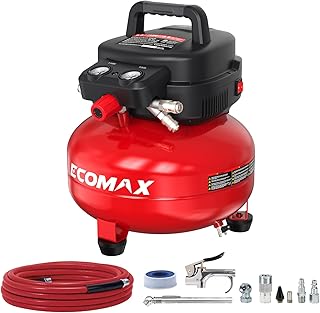 |
Oil-free | 6 Gal | 150 PSI | ~78 dB | $169.99 | Buy at Amazon |
| DEWALT 6-Gallon Pancake |  |
Oil-free | 6 Gal | 165 PSI | ~75 dB | $204.99 | Buy at Amazon |
| PORTER-CABLE 6-Gallon Pancake |  |
Oil-free | 6 Gal | 150 PSI | ~78 dB | $164.00 | Buy at Amazon |
| VEVOR 13-Gallon Quiet |  |
Oil-free | 13 Gal | 125 PSI | 66 dB | $220.90 | Buy at Amazon |
| Klutch 20-Gallon |  |
Oil-lubricated | 20 Gal | 175 PSI | ~68 dB | $299.99 | Buy at Amazon |
| Klutch 29-Gallon |  |
Oil-lubricated | 29 Gal | 175 PSI | ~68 dB | $329.99 | Buy at Amazon |
Noise Levels: What Does “Quiet” Really Mean?
Most “quiet” compressors range from 55 dB to 80 dB. For context:
- 55 dB – soft conversation level
- 65 dB – normal office chatter
- 75 dB – vacuum cleaner
- 85 dB – heavy traffic (hearing protection needed above 85 dB)
An oil-lubricated compressor like the Klutch usually runs around 68 dB, while a standard oil-free pancake hits 75–78 dB. However, newer oil-free designs (like the VEVOR 13-Gallon at 66 dB) are closing the gap.
For noise-sensitive spaces, we’ve written a dedicated guide on Best Low-noise Air Compressors for Noise-sensitive Spaces. If you’re wondering exactly how quiet is quiet enough, check out How Many Decibels Is a Quiet Air Compressor?.
Which Type Is Best for Your Application?
For Garage and Home Workshop Use
If you run nail guns, impact wrenches, or air hammers intermittently, an oil-free model like the DEWALT Pancake is an excellent choice. It’s light, starts every time, and requires zero maintenance.
But if you plan to use your compressor continuously – for sandblasting, painting, or running multiple tools at once – go with an oil-lubricated model like the Klutch 29-Gallon. It will last years longer and run noticeably quieter.
For Apartments and Indoor Use
Noise is critical when you live in close quarters. The VEVOR 13-Gallon Quiet oil-free compressor boasts only 66 dB – quiet enough to use in a basement without disturbing upstairs neighbors. For even lower noise, consider a small oil-lubricated unit.
We also have a full resource on Lowest-noise Air Compressors for Apartments and Indoor Use.
For Portable Inflation and Small Jobs
Tire inflation and occasional brad nailing don’t need a huge tank. Compact oil-free compressors like the CRAFTSMAN 2-Gallon ($149.99, 4.1 stars) or the PORTER-CABLE 6-Gallon are perfect. If you want cordless convenience, the DEWALT Tire Inflator 20V ($130.22) or Milwaukee M18 Inflator ($160.00, 4.8 stars) are top-rated battery-powered options.
Maintenance: Oil-free vs Oil-lubricated
Oil-free – Replace the air filter occasionally. No oil to add or change. The pump is sealed, so when it fails, you replace the whole unit.
Oil-lubricated – Check oil level monthly, change oil every 3–6 months (or after 500 hours). Drain the tank daily to prevent rust. With proper care, these machines can run for decades.
If you’re new to compressor maintenance, our Noise Reduction Tips for Air Compressor Setups covers everything from vibration pads to sound-dampening enclosures – and most tips apply equally to both types.
Final Verdict: Which One Should You Buy?
| You Need… | Choose This Type | Best Pick |
|---|---|---|
| Low cost, low maintenance, portable | Oil-free | ECOMAX 6-Gallon |
| Quietest possible operation indoors | Oil-free with low dB rating | VEVOR 13-Gallon 66 dB |
| Heavy-duty, continuous use | Oil-lubricated | Klutch 29-Gallon |
| Compact for small tasks | Oil-free pancake | PORTER-CABLE C2002 |
| Cordless inflation | Oil-free battery-powered | Milwaukee M18 Inflator |
For a broader overview of quiet compressors, visit our pillar page on Quiet Air Compressors for Garages and Home Workshops.
No matter which route you choose, an oil-free compressor will save you maintenance time, while an oil-lubricated model will reward you with longevity and hushed operation. Pick the one that fits your workload, noise tolerance, and budget – and you’ll never dread turning on the air again.