

Angle grinders are famously versatile—they cut metal, grind welds, and clean masonry. But can you use an angle grinder on wood? Absolutely. With the right disc and technique, an angle grinder becomes a powerful tool for shaping, carving, and even sanding wood. However, it’s not a replacement for a circular saw or router. Wood requires a gentler touch and specific attachments.
In this guide, you’ll learn when and how to use an angle grinder on wood, which discs to choose, and the safety steps you cannot skip. We’ll also recommend top-rated grinders—like the DEWALT DWE402—to help you get started.
When to Use an Angle Grinder on Wood
An angle grinder excels at rapid material removal, but it’s aggressive. Use it for tasks where precision isn’t critical or where other tools are too slow.
- Shaping and carving – With a carving disc (e.g., Lancelot or Arbortech), you can scoop out wood quickly for sculptures or notches.
- Removing old paint or rust – A flap disc or wire wheel strips coatings from wood surfaces without excessive gouging.
- Rough cutting – A wood-cutting chainsaw blade can cut through branches or dimensional lumber, but kickback risk is high.
- Sanding and smoothing – Using a sanding pad with grit paper or a flap disc can prep wood for finishing.
Note: An angle grinder is not suitable for fine joinery or consistent straight cuts. For those, stick with a table saw or circular saw.
The Right Attachments for Wood
Using a standard grinding wheel on wood is like using a sledgehammer on a nail—it will tear the wood and may catch. Choose from these wood-specific accessories:
1. Flap Discs
These are ideal for sanding and shaping. They consist of overlapping abrasive flaps that conform to contours. Use 40–80 grit for aggressive stock removal and 120+ for finishing.
2. Carving Discs (Chainsaw Blades)
A wood carving disc (often called a “Lancelot” style) attaches to the grinder and uses carbide teeth. It removes wood extremely fast, but it’s also dangerous—kickback is common. Only use with a grinder that has a paddle switch and Kickback Brake, like the DEWALT DCG413B cordless model.
3. Sanding Pads
These fit with a backing pad and let you attach hook-and-loop sandpaper. Great for smoothing edges or concave surfaces. Choose a variable-speed grinder to avoid burning the wood.
4. Wire Wheels
Wire wheels (brass or steel) are excellent for stripping paint from wood. Be careful not to press too hard, or the wires can gouge the surface.
Avoid standard grinding wheels—they are meant for metal and stone. They will clog with pitch and can cause the grinder to grab violently.
Safety First – Critical Tips
Using an angle grinder on wood amplifies the normal risks. Wood can cause kickback more easily than metal, and the dust is highly flammable.
- Use a paddle switch – It lets you stop the tool instantly if the grinder snags. See the Bosch GWS8-45 (with a slide switch) vs. paddle models; paddles are safer for woodwork.
- Keep both hands on the grinder – Use the auxiliary handle. Kickback can twist the tool out of your grip.
- Work with the rotation – Let the disc’s direction pull the grinder away from you, not toward your body.
- Wear eye and lung protection – Wood dust is a respiratory hazard; use a mask and safety glasses.
- Avoid using a chainsaw blade on small pieces – They can be thrown violently. Clamp the workpiece securely.
Pro tip: A variable-speed grinder helps prevent burning and gives you better control. The DEWALT DWE4011 is a compact option with a one-touch guard that’s easy to adjust.
Choosing the Best Angle Grinder for Woodwork
Not every grinder is built for wood carving. Look for these features:
- Variable speed – Lower RPM (4,000–8,000) prevents burning and gives control.
- Paddle switch – Safer than slide switches for applications prone to kickback.
- Kickback brake – Stops the disc instantly if the wheel binds.
- Ergonomic body – Wood shaping can take a while; a comfortable grip reduces fatigue.
Top Picks for Woodworking

DEWALT DWE402 – 11 Amp, 11,000 RPM, paddle switch, dust ejection system. Best for aggressive shaping (not variable speed, but high torque). $94.00 – ⭐ 4.8

DEWALT DWE4011 – Compact, 6.5 Amp, one-touch guard. Ideal for light shaping and sanding. $69.00 – ⭐ 4.7

Bosch GWS8-45 – 7.5 Amp, slide switch, 11,000 RPM. Good budget option, but lacks variable speed. $62.10 – ⭐ 4.6

DEWALT DCG413B – Cordless, brushless, 20V MAX, paddle switch, kickback brake. Excellent for portability and safety. $155.99 – ⭐ 4.8
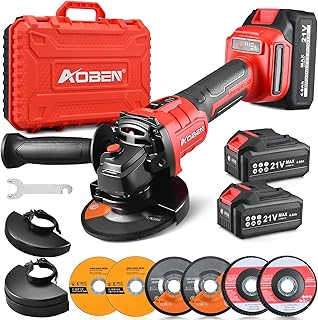
AOBEN Cordless Grinder – 21V, brushless motor, 2×4.0Ah batteries. Great value for occasional woodwork. $58.48 – ⭐ 4.5
Quick Comparison Table
| Product | Image | Price | Rating | Key Features | Buy at Amazon |
|---|---|---|---|---|---|
| DEWALT DWE402 | |
$94.00 | 4.8 | 11 Amp, 11,000 RPM, Paddle Switch, Dust Ejection | Buy Now |
| DEWALT DWE4011 | |
$69.00 | 4.7 | Compact, One-Touch Guard, 6.5 Amp | Buy Now |
| Bosch GWS8-45 | |
$62.10 | 4.6 | 7.5 Amp, Slide Switch, 11,000 RPM | Buy Now |
| DEWALT DCG413B | |
$155.99 | 4.8 | Cordless, Brushless, Kickback Brake, Paddle Switch | Buy Now |
| AOBEN Cordless | |
$58.48 | 4.5 | 21V, Brushless, 2×4.0Ah Batteries | Buy Now |
Other solid choices include the Metabo HPT G12SR4 ($59.00, 6.2 Amp) and the DEWALT DWE402W ($99.00, upgraded dust ejection). For beginners on a budget, the AVID POWER 7.5 Amp ($39.99) comes with starter discs.
Step-by-Step: Using an Angle Grinder on Wood (Carving Example)
- Select your disc – A carving disc (chainsaw style) for roughing out, or a 40-grit flap disc for shaping.
- Secure the workpiece – Clamp it firmly to a workbench. Never hold the piece by hand.
- Adjust the guard – Position it between you and the disc. Wear gloves and a face shield.
- Start at low speed – If your grinder has variable speed, set it to 6,000–8,000 RPM.
- Use light passes – Let the disc do the work. Push too hard and you’ll risk kickback or burning.
- Finish with sanding – Switch to a 120-grit flap disc or sanding pad for a smooth surface.
Related: If you’re also working on metal, check out our guide on How to Cut Metal with an Angle Grinder Cleanly and Safely? and Angle Grinder Techniques for Grinding Welds and Smoothing Metal.
Common Mistakes to Avoid
- Using a standard cutting wheel on wood – It will clog and can shatter.
- Forcing the grinder – Let the tool do the work; excessive pressure causes overheating and kickback.
- Ignoring dust buildup – Wood dust is combustible. Clean your grinder’s vents regularly.
- Working without a guard – On wood, the risk of disc breakage or binding is higher; always use the guard.
Final Verdict
Yes, you can use an angle grinder on wood, but only with the right attachments and precautions. It’s excellent for rapid shaping, carving, and stripping paint—tasks where other tools struggle. For precision cuts or fine joinery, stick with a circular saw or router.
A good grinder for woodwork balances power and control. We recommend the DEWALT DWE402 for its paddle switch and reliability, or the cordless DEWALT DCG413B for portability with kickback protection.
For masonry work, see Using an Angle Grinder on Masonry: Cutting Brick, Block, and Concrete. If you’re tackling tile, our Angle Grinder Tile Cutting Tips for Cleaner Edges and Less Chipping will help.
And don’t forget automotive uses: Automotive Angle Grinder Uses: Rust Removal, Body Prep, and Surface Finishing is a great read.
Bottom line: An angle grinder can be a woodworker’s roughing tool—just pair it with the right disc and respect its power.