

Choosing the right air compressor for your shop or job site means more than just looking at maximum PSI and tank size. One of the most critical—and often misunderstood—specifications is the duty cycle. Whether you’re running a small home garage or a bustling automotive shop, understanding duty cycle helps you avoid overheating, premature wear, and costly downtime.
In this guide, we’ll break down what duty cycle means, why it matters for commercial applications, and how to pick a compressor that matches your workload. We’ll also highlight top-rated models like the Klutch 29-Gallon Air Compressor and the DEWALT Pancake Air Compressor (DWFP55126) to show you how each fits different duty cycle needs.
What Is Duty Cycle in an Air Compressor?
Duty cycle is the percentage of time a compressor can run within a given period, usually measured over a 10-minute cycle. For example, a 50% duty cycle means the compressor can operate for 5 minutes out of every 10 minutes; the remaining 5 minutes it must rest and cool down.
- Formula: Run time ÷ (Run time + Rest time) × 100.
- Example: Running for 4 minutes, then resting for 6 minutes = 40% duty cycle.
This ratio is crucial because continuous operation without adequate cooling can overheat the pump and damage internal components. Commercial-grade compressors often have higher duty cycles than consumer models, allowing them to power tools like impact wrenches and spray guns for longer stretches.
Why Duty Cycle Matters for Commercial Use
In a busy workshop, time is money. A compressor that shuts off too soon due to a low duty cycle can stall your workflow. On the other hand, a unit with a high duty cycle can handle heavy, continuous demand without breaking a sweat.
For instance, an auto body shop running a spray gun needs near-100% duty cycle because the tool runs almost constantly. Likewise, a construction site using nail guns may only need a 50–75% duty cycle because the gun fires intermittently.
If you’re unsure about matching compressor type to your specific needs, check out our guide on How to Choose an Industrial Air Compressor for Your Shop?
Key Points to Remember:
- Overheating risk: Low duty cycles force longer rest periods. Overriding them can burn out the motor.
- Tool requirements: Continuous-use tools demand higher duty cycles.
- Tank size helps, but doesn’t replace duty cycle: A larger tank stores more air, but the pump still needs to recharge. Duty cycle determines how fast it can recover without overheating.
Factors That Affect Duty Cycle
Not all compressors are built the same. Several design and environmental factors influence how long a unit can safely run.
1. Pump Type (Oil-Free vs. Lubricated)
- Oil-free pumps are lighter and require less maintenance, but they typically have lower duty cycles (often 25–50%) because they rely on non-metal components that dissipate heat less effectively.
- Lubricated (oil-bath) pumps have better heat management and can sustain higher duty cycles (50–100%). They are common in commercial and industrial models.
2. Tank Capacity
A larger tank stores more air, which can reduce how often the pump cycles on. However, the duty cycle still applies to the pump itself. For example, the Klutch 20-Gallon Air Compressor provides a good balance of capacity and pump durability for medium-duty tasks.
3. Ambient Temperature and Ventilation
Hot environments and poor airflow increase pump temperature, effectively lowering the safe duty cycle. Always place your compressor in a well-ventilated area.
4. Motor Protection Features
Some compressors include thermal overload switches or auto-reset breakers that shut down the unit if it gets too hot, protecting the motor. This is a sign that the manufacturer expects users to push the duty cycle limit.
How to Calculate Your Required Duty Cycle
To avoid buying too much or too little compressor, estimate how often your tools will actually demand air.
- List your tools and their CFM (cubic feet per minute) requirements.
- Estimate usage pattern: Will you run a tool for 2 minutes then switch to a different task? Or hold a trigger for 20 minutes straight?
- Add a safety margin: Commercial shops often multiply the expected run time by 1.5 to account for surges.
Example:
- Impact wrench runs for 6 minutes every 10 minutes → 60% duty cycle needed.
- With safety margin → choose a compressor rated at 75% duty cycle or higher.
For a deeper dive into air delivery and system reliability, read Air Delivery and Reliability in Factory Air Compressor Systems.
Duty Cycle and Compressor Types
Portable Compressors (Pancake, Hot Dog, Twin-Stack)
These are often oil-free with duty cycles around 25–50% . Perfect for trim work, inflating tires, and driving finish nails. The ECOMAX Air Compressor 6 Gallon 150 PSI is an excellent example with a high 4.7 rating for light-to-medium tasks.
Stationary / Vertical Compressors
Designed for fixed installation, these often have oil-lubricated pumps and duty cycles of 50–100% . They can power multiple workstations or continuous spray guns. The Klutch 29-Gallon Air Compressor 2.5 HP offers 175 PSI and a robust pump suitable for extended use.
Tire Inflators & Specialty Units
Battery-powered inflators like the DEWALT Tire Inflator (DCC020IB) have their own duty cycle (often 100% intermittent usage, but limited by battery life). They excel at portability but can’t replace a shop compressor for continuous air delivery.
If you work on a construction site or heavy-use environment, see our recommendations in Best Air Compressors for Construction Sites and Heavy Use.
Common Duty Cycle Ratings and What They Mean
| Duty Cycle | Typical Run Time per 10 Minutes | Best For |
|---|---|---|
| 25% | 2.5 min run – 7.5 min rest | Light brad nailers, air dusters |
| 50% | 5 min run – 5 min rest | Moderate use: framing nailers, ratchets |
| 75% | 7.5 min run – 2.5 min rest | Heavy framing, continuous sanding |
| 100% | 10 min run – no rest (or active cooling) | Spray painting, sandblasting, factory automation |
Many portable compressors advertise “continuous duty” for cordless inflators but actually mean they can run until the battery dies. True 100% duty cycle compressors are typically large, lubricated units with robust cooling fins and possibly a fan.
The ETENWOLF VORTEX S6 Tire Inflator boasts a 100% duty cycle because it uses a dual-cylinder pump and large battery for heavy-duty automotive use, though it’s still limited by its battery runtime.
Top Air Compressors Compared by Duty Cycle and Performance
Below is a comparison of five popular models that cover a wide range of duty cycles and commercial applications. Click any image or “Buy Now” to see current pricing on Amazon.
| Product | Image | Price | Rating | Key Features | Buy Now |
|---|---|---|---|---|---|
| Klutch 29-Gallon, 2.5HP |  |
$329.99 | 4.4 | 175 PSI, 2.5 HP, oil-free twin-stack, 50% duty cycle | Buy Now |
| Klutch 20-Gallon, 2HP |  |
$299.99 | 4.4 | 175 PSI, 2 HP, 20-gallon vertical, oil-free | Buy Now |
| ECOMAX 6-Gallon 150 PSI Pancake | 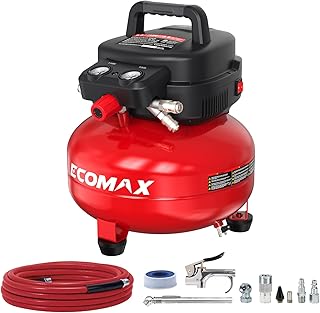 |
$169.99 | 4.7 | Oil-free, 10-piece accessory kit, 6 gal pancake, 50% duty cycle | Buy Now |
| DEWALT Pancake 6-Gallon (DWFP55126) |  |
$204.99 | 4.6 | 165 PSI, oil-free, 6 gal, high-flow regulator, ~50% duty cycle | Buy Now |
| PORTER-CABLE 6-Gallon Pancake (C2002-ECOM) |  |
$164.00 | 4.6 | Oil-free, 6 gal pancake, 150 max PSI, low amp draw (8A) | Buy Now |
Note: Most oil-free pancake/portable compressors have a 50% duty cycle. For higher duty cycles, look for lubricated or large stationary units.
Tips for Maximizing Duty Cycle and Compressor Life
Even if your compressor is rated for 75% duty cycle, how you operate it matters. Follow these best practices:
- Allow proper cool-down time. Don’t restart the compressor immediately after it shuts off. Let the thermal overload reset naturally.
- Keep the pump area clean. Dust and debris insulate heat. Wipe down cooling fins regularly.
- Use an auxiliary receiver tank. Adding a second tank can reduce how often the pump cycles on, effectively lowering the percentage of duty cycle needed.
- Upgrade to a lubricated pump if you consistently need longer run times. Oil-bath compressors are built for commercial duty cycles.
For multi-station setups, refer to Planning a Compressed Air System for Multiple Workstations to ensure proper pipe sizing and moisture control.
And if you run an automotive shop, see what pros demand in Automotive Shop Air Compressors: What Professionals Look for.
Final Thoughts
Duty cycle is not just a number on a spec sheet—it’s a practical guide to how much work your compressor can handle without overheating. For light home use, a 50% duty cycle from a quality pancake compressor like the ECOMAX 6-Gallon or PORTER-CABLE C2002 will serve you well. For heavier commercial tasks, step up to a larger tank and higher-rated pump such as the Klutch 29-Gallon or Klutch 20-Gallon.
Always match the duty cycle to your most demanding tool. When in doubt, choose a higher duty cycle than you think you need—it’s cheaper than a failed motor in the middle of a job.