

A cordless drill is arguably the most versatile tool in any DIY homeowner’s arsenal. Whether you’re assembling flat-pack furniture, drilling pilot holes for shelves, or driving screws into studs, the right cordless drill makes the job faster and safer. But with dozens of models, voltage classes, and battery platforms on the market, choosing the perfect drill can feel overwhelming.
This guide breaks down every key spec, feature, and trade-off so you can buy with confidence. We’ll also explore how air compressors and pneumatic tools complement your cordless setup—because a truly well-equipped workshop uses both. By the end, you’ll know exactly what to look for and which tools deserve a spot in your garage.
Understanding Cordless Drill Basics
Before you compare prices or brands, master the core specifications that determine a drill’s real-world performance.
Voltage and Power
Voltage is the simplest proxy for power. Common options include:
- 12V: Light, compact, perfect for electronics and light furniture assembly. Not for heavy-duty drilling.
- 18V / 20V Max: The sweet spot for most DIYers. Handles drilling into wood, drywall, and even thin metal. Driving large screws is easy.
- 24V+: Overkill for most homeowners. These are for pros driving lags all day. They’re heavy and expensive.
Rule of thumb: Choose 18V (or 20V Max—same thing, different marketing) unless you need absolute lightness for overhead work.
Battery Platforms and Lock-In
Once you buy into a brand’s battery system, you’re often locked in for years. That’s why smart shoppers pick the platform first, the drill second.
Popular platforms include:
- DEWALT 20V MAX (one of the largest ecosystems)
- CRAFTSMAN V20 (shared with Stanley Black & Decker)
- PORTER‑CABLE 20V MAX
- Milwaukee M18, Makita 18V LXT, Ryobi 18V ONE+
Key insight: If you already own a battery platform (say, from a homeowner’s circular saw or trimmer), buy a drill from the same family. You’ll save on batteries and chargers.
Brushless vs Brushed Motors
| Feature | Brushed | Brushless |
|---|---|---|
| Efficiency | Lower (more energy lost as heat) | Higher (up to 50% more runtime) |
| Torque | Good at low speeds | Better at all speeds, especially high |
| Lifespan | Shorter (brushes wear out) | Longer (no brushes to replace) |
| Cost | Cheaper | Typically $20–40 more |
| Size | Slightly larger | More compact for same power |
Verdict: For any serious DIY use, brushless is worth the premium. You get longer battery life, more consistent power, and less maintenance. If you only drill once a month, a brushed model still works fine.
Chuck Size and Type
Most cordless drills sold today have a keyless chuck. The size (3/8″ vs 1/2″) determines the maximum drill bit shank diameter.
- 3/8″ chuck: Accepts bits up to 3/8″ hex shank. Fine for light driving and small holes.
- 1/2″ chuck: Accepts larger bits and spade bits. Standard for 18V drills.
Some premium models include a metal chuck instead of plastic, which grips better and lasts longer.
Clutch Settings and Speed Control
A clutch prevents over‑driving screws into soft materials. More clutch settings = finer control. Look for at least 15+ settings on an 18V drill.
Two speeds are standard:
- Low speed (0–400 RPM): High torque for driving screws.
- High speed (0–1500–2000 RPM): Low torque for drilling.
Some drills add a hammer drill mode (for masonry). Only buy this if you plan to drill into brick or concrete occasionally.
Key Features to Look For
Beyond the basics, these features separate a mediocre drill from a joy to use.
Torque and Speed Ratings
Manufacturers list torque in inch‑pounds (in‑lbs) or UWO (unit watts output). For DIY, look for:
- 350–500 in‑lbs for light work (12V)
- 500–800 in‑lbs for general 18V drilling
- 800+ in‑lbs for serious driving (framing, lag bolts)
Speed matters less; most 18V brushless drills reach 1,700–2,000 RPM in high gear, which is plenty.
Weight and Ergonomics
You’ll hold the drill for hours. Weight becomes critical.
- 12V drills: 2–3 lbs
- 18V brushed: 3.5–4.5 lbs
- 18V brushless: 3–4 lbs
Look for a rubber overmold grip and a balanced design (battery slides in the bottom of the handle). Try to hold a display model before buying.
LED Light, Belt Clip, and Bit Holder
A bright LED light positioned above the trigger illuminates your work area. Some high‑end drills offer three‑mode lights (always on, trigger, dim). Belt clips and magnetic bit holders seem small but save countless trips back to the toolbox.
Cordless Drill or Impact Driver?
Many DIYers confuse drills with impact drivers. They are not the same.
| Tool | Best for | Why |
|---|---|---|
| Cordless drill | Drilling holes, driving screws in soft materials, mixing paint | Adjustable clutch, runs smoothly |
| Impact driver | Driving long screws, lags, or working with dense wood | High‑torque bursts, no clutch stalling, reduces wrist fatigue |
When you need both: An impact driver excels at deck screws and framing. A drill handles precise work. Many homeowners start with a combo kit (drill + impact driver) to cover all bases.
Battery and Charger Considerations
Your drill is only as good as its battery.
- Amp‑hour (Ah) rating: Higher Ah = longer runtime. For a drill, 2.0–3.0 Ah is fine for occasional use. 4.0–5.0 Ah gives all‑day power.
- Charger speed: A fast charger (30–60 min) is worth the extra cost. Slow chargers (2+ hours) are frustrating mid‑project.
- Battery care: Lithium‑ion batteries degrade if stored fully discharged or in extreme heat. Keep them at 40–80% charge in a cool, dry place.
Top Cordless Drill Brands (And Their Platforms)
You don’t need the most expensive drill to succeed as a DIYer. But brand reputation matters for warranty, parts, and future tool compatibility.
- DEWALT: Industry standard for pros. The 20V MAX platform has hundreds of tools. Brushless models like the DCD791 are excellent.
- CRAFTSMAN: Great value for homeowners. Their V20 system is shared with Porter‑Cable and Bostitch.
- PORTER‑CABLE: Solid mid‑tier drills, often on sale.
- Ryobi: Huge ecosystem, affordable, ideal for light‑to‑medium DIY.
- Milwaukee: Top‑tier for pros. The M18 Fuel line is brushless and powerful, but expensive.
- Makita: Excellent ergonomics, reliable, but slightly smaller tool selection.
Pro tip: Buy a drill and impact driver combo from your chosen platform. The savings are often 30–50% vs buying separately.
When an Air Compressor Is the Better Choice
Even the best cordless drill can’t match an air compressor for sustained, heavy‑duty tasks. Pneumatic tools are lighter, cheaper, and never run out of battery. For a DIY homeowner, a small compressor (2–6 gallons) opens a world of possibilities:
- Brad nailers for trim work
- Spray guns for painting furniture
- Air hammers and die grinders
- Tire inflation (cars, bikes, wheelbarrows)
But which compressor is right for you? Here are the top‑rated models that belong in any home garage.
CRAFTSMAN 2‑Gallon Portable Air Compressor

Key specs: 1/3 HP, max 125 PSI, oil‑free, comes with 10‑piece accessory kit.
This ultra‑lightweight compressor (just 24 lbs) is perfect for brad nailers and inflation. Rating: 4.0 | Price: $129.99
ECOMAX 6‑Gallon 150 PSI Pancake Compressor
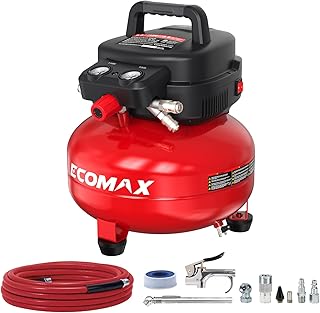
Key specs: Oil‑free pancake design, 150 PSI max, includes 10 accessories.
With a 4.7 rating, this is a steal for homeowners who need more capacity for framing nailers or light painting. Price: $169.99
PORTER‑CABLE 6‑Gallon Pancake Oil‑Free (C2002‑ECOM)

Rating: 4.6 | Price: $164.00 — A classic, reliable pancake that has been a bestseller for years. Ideal for staplers and brad nailers.
DEWALT 6‑Gallon 165 PSI Pancake (DWFP55126)

Rating: 4.6 | Price: $204.99 — Higher PSI means faster recovery. It runs multiple nailers simultaneously without dropping pressure.
Need help sizing? Read our guide on How to Choose the Right Air Compressor Size for a Home Garage. Also compare Oil-Free vs Oil-Lubricated Air Compressors.
Tire Inflators: A Handy Addition to Your Garage
Even if you don’t buy a full compressor, a cordless tire inflator is one of the most practical tools for vehicle maintenance. The CRAFTSMAN and DEWALT inflators are compact, run on your drill batteries, and automatically shut off at a set pressure.
DEWALT 20V MAX Tire Inflator (DCC020IB)
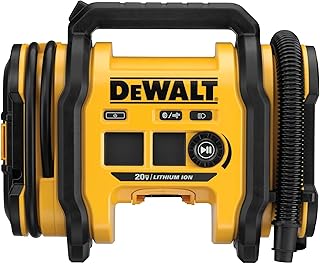
Rating: 4.6 | Price: $130.22 (tool only). Digital gauge, automatic shut‑off, and LED work light. If you own DEWALT 20V batteries, this is a no‑brainer.
CRAFTSMAN V20 Cordless Tire Inflator (CMCE521B)

Rating: 4.6 | Price: $39.00 (tool only). Up to 150 PSI, compact, and incredibly affordable. Works with CRAFTSMAN V20 batteries.
CRAFTSMAN V20 Multi‑Mode Tire Inflator (CMCE520B)
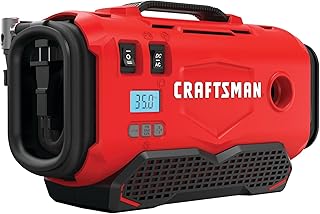
Rating: 4.4 | Price: $49.00 (tool only). Three power options: cordless, 120V corded, or 12V car adapter. Extremely versatile.
For more details on choosing the right hose and fittings, read our Air Hose Size Guide.
Air Tools to Expand Your Capabilities
Once you have a compressor, affordable air tools let you do jobs that would otherwise require expensive cordless variants.
DYNAMIC POWER 50‑Piece Air Tool Kit (D‑W3‑50K)

Rating: 4.4 | Price: $99.99 — Includes 1‑1/2″ impact wrench, 1‑3/8″ ratchet wrench, air hammer with chisels, and more. Perfect for automotive work.
JASTIND Industrial Air Blow Gun
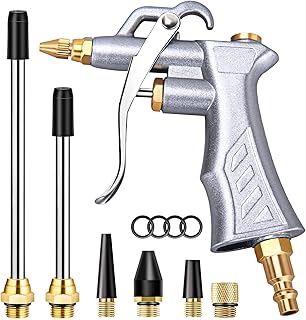
Rating: 4.6 | Price: $11.99 — Brass adjustable nozzle, steel extensions. Essential for cleaning sawdust from tools and workbenches.
High Volume Industrial Air Blow Gun

Rating: 4.6 | Price: $12.99 — Extendable 17–26″ stainless steel nozzle with 360° swivel hook. Great for reaching tight spaces.
Learn how to maintain your compressor by checking our Air Compressor Maintenance Schedule and troubleshooting tips for Common Air Compressor Problems and How to Fix Them.
Putting It All Together – Your DIY Workshop Setup
A cordless drill is your everyday workhorse. Pair it with a compatible battery platform and you can expand into circular saws, reciprocating saws, and lights without buying extra batteries.
But don’t ignore pneumatics. A small 6‑gallon compressor like the DEWALT DWFP55126 or PORTER‑CABLE C2002 lets you use air nailers (far lighter than battery‑powered ones) and blow guns. Add a quality tire inflator and you’ll wonder how you managed without one.
For workshop organization, read our guides on Pegboard vs Slatwall and Lighting a Workshop.
Final Thoughts
Choosing the right cordless drill comes down to matching voltage, motor type, and battery platform to your typical projects. For almost all DIY homeowners, an 18V (20V Max) brushless drill with a 1/2″ metal chuck and a 2.0‑5.0 Ah battery is the gold standard. Buy a combo kit with an impact driver if your projects involve lots of screws.
Then, round out your tool collection with an air compressor that fits your space and tasks. The ECOMAX 6‑gallon and CRAFTSMAN 2‑gallon options above are excellent, affordable starting points.
Invest smart, maintain your tools, and you’ll build with confidence for years.
Still have questions about battery platforms? See our deep dive on Battery Platform Lock-In: How to Pick a Tool Brand.