

When the lights go out, a home generator becomes the difference between chaos and comfort. Whether you need to keep refrigerators running, sump pumps operational, or simply charge phones, picking the right generator requires careful thought. This guide will walk you through every factor, from wattage calculations to fuel types, and show how compressors and power tools play a supporting role during outages.
Modern homes depend on electricity for heating, cooling, water, and communication. A single blackout can spoil food, freeze pipes, or flood a basement. Investing in a generator is not just a luxury—it’s a proactive step for safety and peace of mind.
Before you shop, consider your specific needs. Do you want to power a few essentials or your entire house? Are you comfortable handling gasoline, or would a dual-fuel or solar model suit you better? Let’s break it all down.
Understanding Generator Types
Generators fall into two broad categories: portable and standby. Each serves a different purpose and budget.
Portable Generators
Portable generators are versatile, affordable, and easy to store. They run on gasoline, propane, or diesel and require manual setup during an outage. Most models produce between 2,000 and 10,000 watts.
Best for: Camping, job sites, or powering a few critical appliances at home.
Pros:
- Lower cost (starting around $300)
- Can be moved anywhere
- Simple maintenance
Cons:
- Requires manual starting and refueling
- Must be kept outdoors (CO risk)
- Limited runtime (usually 6–12 hours per tank)
Standby Generators
Standby generators install permanently outside your home and connect directly to your electrical panel. They turn on automatically within seconds of a power loss, run on natural gas or propane, and can power an entire house.
Best for: Homes where uninterrupted power is critical (medical equipment, home offices, large families).
Pros:
- Automatic start
- No fuel storage hassle (if natural gas)
- Can run for days
Cons:
- High upfront cost ($2,000–$15,000+)
- Professional installation required
- Annual maintenance
Inverter Generators
Inverter generators produce clean, stable power ideal for sensitive electronics like computers and smart TVs. They are usually quieter and more fuel-efficient than conventional portable models.
Best for: Camping, tailgating, and backup for electronics.
Pros:
- Low total harmonic distortion (THD) – safe for devices
- Quiet operation
- Parallel capability (link two units for more power)
Cons:
- Higher cost per watt
- Lower maximum output
For a deeper dive into inverter vs conventional models, check out our guide on Inverter vs Conventional Generator: What’s the Real Difference.
Sizing a Generator for Your Home
Getting the wattage right prevents overload and wasted fuel. You need two numbers: running watts and starting watts.
- Running watts keep an appliance on (e.g., a fridge uses 600–800 watts).
- Starting watts are the extra surge needed to start motors (e.g., a fridge can draw 2,000+ watts for a few seconds).
Step 1: List Essential Items
Make a list of what you absolutely need to power during an outage:
| Appliance | Running Watts | Starting Watts |
|---|---|---|
| Refrigerator (energy star) | 600 | 2,000 |
| Freezer | 700 | 2,200 |
| Sump pump (1/2 HP) | 800 | 1,800 |
| Furnace fan (gas) | 750 | 1,400 |
| Well pump (1/2 HP) | 1,000 | 3,000 |
| Lights (10 LEDs) | ~100 | 100 |
| TV + modem | 200 | 0 |
| Microwave | 1,000 | 0 |
| Window AC (10,000 BTU) | 1,200 | 1,800 |
Add up the running watts of all items you plan to run simultaneously. Then add the single highest starting watt. This total is your minimum generator rating.
Example: Fridge (600 run, 2,000 start) + sump pump (800 run, 1,800 start) + lights (100) + TV (200) = 1,700 running watts plus 2,000 starting surge = 3,700 watts. A 4,000-watt generator would work.
Rule of thumb: Multiply total running watts by 1.5 to be safe.
Step 2: Account for Future Tools
During an outage, you might also use power tools. An air compressor can be invaluable for inflating tires, running pneumatic tools, or cleaning debris. If you own a compressor like the PORTER-CABLE Air Compressor, 6-Gallon, Pancake, Oil-Free (C2002-ECOM), it draws about 1,200 running watts with a 2,200 start surge. Factor that into your generator size.

Fuel Types: Gasoline, Propane, Diesel, and Dual-Fuel
Your choice of fuel determines runtime, cost, and convenience.
Gasoline
- Availability: Easy to find
- Shelf life: 3–6 months (with stabilizer)
- Pros: Low initial cost
- Cons: Requires frequent refueling; can gum up carburetors; heavy to store (6 lbs/gallon)
Propane
- Availability: Sold in tanks or refillable cylinders
- Shelf life: Indefinite
- Pros: Clean-burning, longer engine life, good for dual-fuel generators
- Cons: Lower energy density (less watts per gallon); tanks are bulky
Diesel
- Availability: Limited at gas stations
- Shelf life: 6–12 months (with additive)
- Pros: High efficiency, durable engines
- Cons: Loud, expensive, harder to start in cold weather
Natural Gas (Standby)
- Availability: Connected to utility line
- Pros: Unlimited fuel, no storage
- Cons: Not available everywhere; lost if gas pipeline fails
Dual-fuel generators (gasoline + propane) offer the most flexibility. They let you switch fuels depending on availability. Many portable generators now come dual-fuel as standard.
For safe fuel handling, see our guide on Safe Fuel Storage for Generators and Power Tools.
Key Features to Look For
Not all generators are equal. Beyond wattage and fuel, evaluate these features.
Run Time
Look for 20+ hour run times at 25% load on a full tank. This reduces refueling frequency during long outages. Inverter generators often run longer on less fuel.
Noise Level
Measured in decibels (dBA). A difference of 3 dBA is double the sound. Standard portable generators run 65–85 dBA. Inverter models can be as low as 52 dBA. If you live close to neighbors or need quiet for sleeping, invest in a quiet generator.
Outlets
Ensure the generator has enough outlets for your needs:
- Duplex 120V household outlets
- 240V twist-lock (for well pumps or larger appliances)
- USB ports for charging devices
Electric Start
Battery-powered start is a luxury that saves pulling a cord, especially in cold weather. Most generators over 4,000 watts offer this.
Parallel Capability
Two inverter generators can be connected to double output. This allows you to start with a smaller unit and add capacity later.
Automatic Voltage Regulation (AVR)
AVR keeps voltage stable, protecting sensitive electronics. It is standard on most inverter generators.
Safety Considerations
Generators produce carbon monoxide (CO) – a colorless, odorless gas that can kill in minutes. Never run a generator indoors, in garages, or near open windows.
CO Shutdown Sensors
Modern models include automatic shutdown when CO levels get dangerous. Look for generators certified to ANSI/PGMA G300-2018 standard.
Transfer Switches
For portable generators, you can plug devices directly into the generator or use a transfer switch connected to your breaker panel. A transfer switch prevents backfeeding (dangerous to utility workers) and lets you power hardwired circuits.
Backfeeding (plugging a generator into a wall outlet using a male-to-male cord) is illegal and deadly. Always use a proper transfer switch or interlock kit.
Grounding
Portable generators typically do not need grounding when powering equipment through their outlets. If you connect to a home panel via a transfer switch, follow the manufacturer’s grounding instructions.
Extension Cords
Use heavy-duty, outdoor-rated cords rated for the wattage you are drawing. Keep them short to reduce voltage drop. For long runs, consider a 30-amp twist-lock cord.
Integrating Air Compressors and Power Tools into Your Outage Plan
An outage might force you to inflate car tires after a storm or use pneumatic tools for emergency repairs. An air compressor can run on generator power if sized correctly.
Why an Air Compressor Matters During a Blackout
- Tire inflation: After driving over debris, you may need to top up tires.
- Pneumatic tools: A blow gun or impact wrench can speed up repairs.
- Cleaning: Compressed air clears debris from vents or tools.
- Pressure testing: Check for gas line leaks after a quake.
We reviewed several compressors that pair well with a generator. The DEWALT Pancake Air Compressor, 6 Gallon, 165 PSI (DWFP55126) is a popular choice. It runs on 120V AC and draws about 1,500 starting watts, easily handled by a 3,000-watt generator.

Matching Compressor to Generator
Use this table to ensure your generator can start and run a compressor:
| Compressor | Running Watts | Starting Watts | Min Generator Size |
|---|---|---|---|
| CRAFTSMAN 2 Gallon 125 PSI | 600 | 1,200 | 2,000W |
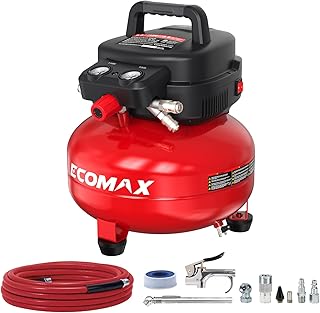
| ECOMAX 6 Gallon 150 PSI | 1,100 | 2,200 | 3,500W |
| PORTER-CABLE 6 Gallon 150 PSI | 1,200 | 2,200 | 3,500W |
| DEWALT DWFP55126 6 Gallon 165 PSI | 1,200 | 2,200 | 3,500W |
The ECOMAX Air Compressor 6 Gallon 150 PSI Pancake (rating 4.7) is an excellent oil-free model that stays quiet and starts reliably.
Cordless Compressor Options
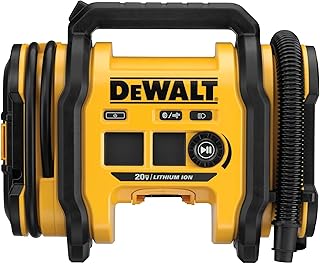
If you already own a cordless tool system, a battery-powered inflator can be a lightweight alternative. The DEWALT Tire Inflator Portable Air Compressor 20V MAX (DCC020IB) runs on DEWALT batteries. It has automatic shutoff and an LED light. At $130.22, it’s great for quick tire jobs without needing a generator.
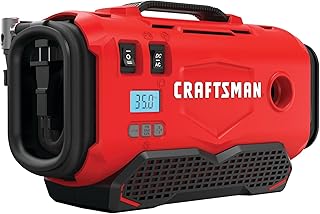
Similarly, the CRAFTSMAN V20 Air Compressor Portable (CMCE521B) offers up to 150 PSI and digital gauge—only $39 for the bare tool.

For cordless versatility, the CRAFTSMAN V20 Tire Inflator (CMCE520B) works as a 3-in-1: cordless, 120V corded, or 12V car adapter. At $49, it’s a backup essential.
Pneumatic Accessories to Have on Hand
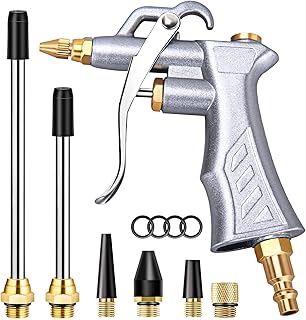
During an outage, cleaning up is easier with compressed air. The JASTIND Industrial Air Blow Gun ($11.99, 4.6 stars) features a brass adjustable nozzle and steel extensions. It’s perfect for blowing dust out of electronics or clearing snow from generator vents.
For a larger kit, the DYNAMIC POWER 50 Pieces Air Tool Kit ($99.99, 4.4 stars) includes an impact wrench, ratchet, air hammer, and chisels. This set can handle vehicle repairs or demolition work after a storm.

The High Volume Powerful Industrial Air Blow Gun ($12.99, 4.6 stars) extends from 17 to 26 inches and has a 360-degree swivel hook. It’s ideal for hard-to-reach areas.

Installation and Setup Tips
Portable Generator Setup
- Location: Place at least 20 feet from home, away from doors and windows. Use a generator tent or canopy if rain is expected.
- Fuel: Use fresh gasoline with stabilizer. Store fuel in approved containers.
- Cords: Use a heavy-duty outdoor extension cord (10 or 12 gauge) for long runs. Avoid daisy-chaining.
- Load: Start the generator, let it warm up 2–3 minutes, then plug in appliances one at a time.
- Shutdown: Turn off all loads, let generator cool 5 minutes, then turn off fuel valve.
Standby Generator Installation
Hire a licensed electrician. They will:
- Install a concrete pad
- Run natural gas or propane lines
- Connect a transfer switch (automatic or manual)
- Wire to your main panel
Expect costs of $2,000–$5,000 for a 10–14kW unit, plus installation.
Maintenance Schedule
- Every 30 hours: Check oil level, clean air filter
- Every 100 hours: Change oil and oil filter
- Every season: Drain old fuel, run under load for 30 minutes, check battery (if electric start)
For portable generators, a monthly load test keeps the engine healthy. For compressors, follow the Air Compressor Maintenance Schedule: A Monthly Checklist.
Generators vs. Other Power Sources
Some homeowners consider solar generators (battery packs) for quiet, emission-free backup. They are excellent for small loads (phones, lights, small fridge) but cannot sustain high-draw items like well pumps or air compressors for long.
When to choose solar/battery:
- Short outages (under 8 hours)
- Sensitive electronics
- No fuel storage allowed
When to choose gas/propane generator:
- Long outages (days)
- High-wattage tools
- Heating/cooling needs
If you need to run a compressor or power tools, a fuel-powered generator is almost always necessary.
Real-World Scenarios: Which Generator Fits?
Scenario 1: Apartment or Townhouse with Limited Storage
You have a balcony and need to keep a fridge, phones, and a window AC running. A 2,000–3,000 watt inverter generator like a Honda EU2200i is quiet and light. Pair it with a CRAFTSMAN V20 Tire Inflator for quick tire checks.
Scenario 2: Suburban Home with a Family
You want to run fridge, freezer, sump pump, lights, and a microwave. A 5,000–7,500 watt dual-fuel portable generator is ideal. It can also power a PORTER-CABLE 6-Gallon Pancake Compressor for home repairs.
Scenario 3: Rural Property with Well Pump and Furnace
You need 240V for the well pump and furnace. A 10,000–15,000 watt standby generator on natural gas is the best solution. It will handle an ECOMAX 6 Gallon Compressor without breaking a sweat.
Frequently Asked Questions
Can I run an air compressor on a small generator?
Yes, as long as the generator’s starting watts exceed the compressor’s starting surge. For a small craftsman compressor (1,200W start), a 2,000W generator works.
How long can a generator run continuously?
Most portable generators can run 8–12 hours at 50% load before needing a break to cool down and refuel. Standby generators can run indefinitely with proper maintenance.
Is it safe to store gasoline for a generator?
Store gasoline in UL-listed containers, away from living areas and ignition sources. Use a fuel stabilizer and rotate fuel every 3 months.
What size generator do I need for a 6-gallon air compressor?
A 6-gallon pancake compressor (like the DEWALT DWFP55126) needs at least 3,500 starting watts. A 4,000-watt generator is recommended.
Final Thoughts
Choosing a generator for home power outages is about matching your needs, budget, and lifestyle. Start by calculating your essential loads, then decide on fuel type and portability. Don’t forget the supporting tools—an air compressor and pneumatic accessories can make a post-storm recovery far easier.
Always prioritize safety: proper ventilation, correct cords, and a transfer switch. And remember that a generator is only as reliable as its maintenance. Run it monthly, keep fuel fresh, and you will have peace of mind when the next storm hits.
For more insights on workshop setup and tool integration, read Setting Up Your First Workshop: Tools Every Beginner Needs and understand how your compressor fits into a larger power ecosystem.
Now that you have the complete picture, you are ready to make an informed purchase. Whether you choose a portable dual-fuel generator or a permanent standby unit, you will keep your home running smoothly when the grid goes dark.