

If you’ve ever leaned over your air compressor while it hums away, wondering if you’re about to trip a breaker or melt a piston, you’re not alone. The question “How long can I run my air compressor continuously?” is one of the most common—and most misunderstood—topics in the workshop.
The short answer: it depends on the compressor’s duty cycle, tank size, tool demand, and cooling ability. But if you push past those limits, you risk overheating, premature wear, and even permanent motor damage.
In this deep dive, you’ll learn exactly what determines continuous run time, how to read duty cycle ratings, and which compressors (like the best-selling CRAFTSMAN Air Compressor, 2 Gallon or the heavy-duty DEWALT Pancake Air Compressor, 6 Gallon) can handle long jobs without breaking a sweat. Let’s dive in.
What Is Duty Cycle? The Core of Continuous Run Time
Every air compressor comes with a duty cycle rating, usually expressed as a percentage (e.g., 50%, 75%, or 100%). This number tells you how long the compressor can run in a given time window before it must rest to cool down.
How Duty Cycle Works
A 50% duty cycle means the compressor can run for 30 minutes out of a 60-minute period. The other 30 minutes are for cooling. Running it longer than that without a break forces internal components—especially the motor, pump, and valves—to operate above safe temperatures.
- Low duty cycle (25–50%) – Common on small, oil-free pancake compressors. Great for intermittent tasks like brad nailing or inflating tires.
- Medium duty cycle (50–75%) – Typical for mid-range portable units. Suitable for longer spraying or stapling sessions.
- High duty cycle (75–100%) – Found on industrial or oil-lubricated compressors. Designed for near-continuous use in production environments.
Why Duty Cycle Matters More Than “Continuous Run”
No compressor can run forever. Even a 100% duty cycle unit needs periodic maintenance (oil changes, belt checks, filter cleaning). The real question is: can it run long enough for your job without overheating?
For light-duty home garage work, a PORTER-CABLE Air Compressor, 6-Gallon with a typical 50–60% duty cycle is perfectly fine for most weekend projects. For professional framing crews or auto body shops, a unit like the DEWALT 6-Gallon Pancake with a higher CFM rating and better cooling lets you run longer between rests.
Key Factors That Affect Continuous Run Time
Even with a documented duty cycle, real-world run time depends on several variables.
1. Tank Size
A larger tank stores more compressed air, so the compressor’s motor runs less frequently. A 2-gallon tank may cycle on every 30 seconds under a heavy load, while a 6-gallon tank can supply air for several minutes before the pump kicks back in.
- Small tanks (1–2 gal) – Best for intermittent inflation and light nailing. Expect short run times (2–5 minutes) before the motor restarts.
- Medium tanks (4–8 gal) – Good for brad nailers, staplers, and spray guns. Run times of 5–15 minutes are typical.
- Large tanks (10+ gal) – Designed for continuous-use tools like impact wrenches, sanders, and paint sprayers. Can run 15–30 minutes or more before needing a cool-down.
2. CFM and SCFM Ratings
CFM (Cubic Feet per Minute) measures how much air the compressor delivers. SCFM (Standard CFM) adjusts for atmospheric conditions. The higher the CFM, the more air the pump moves—but also the more heat it generates.
- Low CFM (1–3 SCFM @ 90 PSI) – Suitable for brad nailers and tire inflators. Run times are longer because the pump cycles less aggressively.
- Mid CFM (3–6 SCFM) – Powers impact wrenches, die grinders, and framing nailers. Run times moderate.
- High CFM (6+ SCFM) – Drives sanders, spray guns, and multiple tools. The pump works harder, so duty cycle becomes critical.
3. Oil-Free vs. Oil-Lubricated
- Oil-free compressors use Teflon-coated pistons and no oil bath. They run hotter and have shorter duty cycles (often 25–50%). They’re lighter and require less maintenance.
- Oil-lubricated compressors have an oil sump that reduces friction and dissipates heat. They can run 70–100% duty cycles and last much longer. But they’re heavier and need periodic oil changes.
For a deep dive on the trade-offs, read our guide: Oil-Free vs Oil-Lubricated Air Compressors: Which One Fits Your Workshop.
4. Ambient Temperature and Ventilation
A compressor running in a hot, unventilated garage (e.g., 100°F) will reach its thermal limit much faster than one in a cool, well-ventilated space. Heat is the number one enemy of compressor longevity.
- Keep a gap of at least 12 inches around the compressor for airflow.
- Avoid placing it near furnaces, dryers, or direct sunlight.
- Consider a fan to circulate air around the pump.
5. Tool Demand
The actual continuous run time of your compressor depends on how much air your tool consumes. A low-drain brad nailer uses little CFM, so the compressor may only run 5 minutes out of every 30. But a high-flow spray gun can drain a 6-gallon tank in under 2 minutes, forcing the compressor to run almost non-stop.
Real-World Examples: How Long Can You Run Popular Models?
Let’s look at actual models from the Amazon best-sellers list.
 CRAFTSMAN Air Compressor, 2 Gallon
- Price: $129.99 | Rating: 4.0
- Type: Oil-free, portable pancake
- Max PSI: 125 | Tank: 2 gal
- Duty cycle: ~25–30% (typical for small oil-free units)
Continuous run time: About 3–5 minutes of pump-on time before thermal protection kicks in. Best for inflating tires, blowing dust, and powering brad nailers for short bursts. Not designed for continuous sanding or spraying.
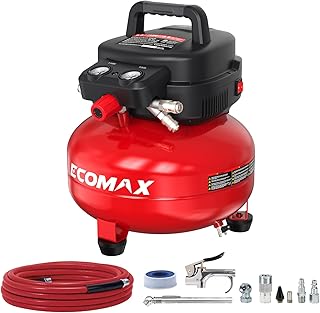 ECOMAX Air Compressor 6 Gallon 150 PSI
- Price: $169.99 | Rating: 4.7
- Type: Oil-free pancake
- Max PSI: 150 | Tank: 6 gal
- Duty cycle: ~50–60%
Continuous run time: 10–15 minutes of continuous pump operation. The larger tank stores more air, which reduces the frequency of cycles. Ideal for framing nailers, staplers, and air chisels in a home garage. The 4.7-star rating reflects its reliability for semi-continuous use.
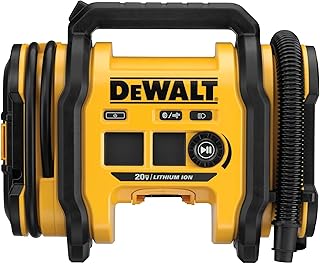 DEWALT 20V MAX Tire Inflator
- Price: $130.22 | Rating: 4.6
- Type: Cordless, battery-powered
- Max PSI: 160 | No tank
This is a different beast—a portable tire inflator, not a traditional compressor. It runs as long as the battery holds out (typically 10–15 minutes per 5Ah battery). The motor has built-in thermal protection and will shut off if overheated. Ideal for emergency inflation, not for workshop tools.
 PORTER-CABLE C2002-ECOM 6-Gallon
- Price: $164.00 | Rating: 4.6
- Type: Oil-free pancake
- Max PSI: 150 | Tank: 6 gal
- Duty cycle: ~50–60%
One of the most popular compressors for DIYers, this model can run 12–15 minutes at a stretch before requiring a 10-minute cool-down. Excellent for trim work, finish nailers, and light spray painting. The oil-free pump is quieter than many competitors.
 DEWALT DWFP55126 6-Gallon
- Price: $204.99 | Rating: 4.6
- Type: Oil-free pancake
- Max PSI: 165 | Tank: 6 gal
- Duty cycle: ~60–70%
With a slightly higher PSI and a high-efficiency pump, this DEWALT can run 15–20 minutes continuously. The high-flow regulator supports multiple tools, and the thermal overload protection automatically resets after cooling. For a home garage tackling heavy-duty nailing or air ratchets, this is a top pick.
Cordless Options for Occasional Use
 CRAFTSMAN V20 Cordless Tire Inflator ($39.00, 4.6★) and CRAFTSMAN V20 Tire Inflator with 3 Modes ($49.00, 4.4★) are perfect for topping off tires without a hose. They run on 20V batteries (not included) and offer run times of 10–20 minutes per charge. Do not use these for continuous workshop tasks—they lack the CFM and tank capacity.
What Happens If You Run an Air Compressor Too Long?
Running a compressor beyond its duty cycle isn’t just a matter of waiting for it to stop. Here’s what can actually happen:
- Motor overheating – The thermal overload switch may trip, cutting power. This is a safety feature, not a failure—but frequent tripping stresses components.
- Pump wear – Excess heat degrades piston rings, valves, and cylinder walls. Oil-free pumps especially suffer.
- Oil breakdown (in lubricated models) – High temperatures thin the oil, reducing lubrication and causing metal-to-metal contact.
- Electrical failure – Overheated motors can melt insulation on windings, causing short circuits and permanent damage.
Signs You’re Pushing Too Hard
- The compressor’s exterior feels hot to the touch (above 180°F).
- The motor’s thermal cutout trips repeatedly.
- You hear unusual knocking or squealing (indicates bearing or piston wear).
- Oil leaks appear (overheated seals harden and crack).
If you notice any of these, shut it down immediately and let it cool for 30 minutes.
How to Determine Your Compressor’s Safe Continuous Run Time
Step 1: Check the Manual
Look for the duty cycle rating. If none is listed, assume 25–30% for most small oil-free models, and 50% for larger ones.
Step 2: Use a Kill-A-Watt or Timer
Plug the compressor into a power meter or use a stopwatch. Note how long the motor runs before it naturally stops (fully pressurizing the tank). Then note how long it rests before restarting.
- Example: Motor runs 4 minutes, rests 6 minutes = 40% duty cycle (4 ÷ 10).
- If you need continuous air, you must stay under that percentage.
Step 3: Match Tool CFM to Compressor CFM
A tool that consumes 5 CFM on a compressor rated for 5 CFM @ 90 PSI will force the pump to run nearly 100% of the time. Oversize your compressor by at least 30% to allow for duty cycle headroom.
Learn how to choose the right size in our guide: How to Choose the Right Air Compressor Size for a Home Garage.
Tips to Extend Continuous Run Time Safely
- Upgrade to a larger tank – More stored air = fewer pump cycles. A 6-gallon model like the ECOMAX gives you a 50% longer continuous air supply than a 2-gallon unit.
- Install a secondary receiver tank – Add a 10–20 gallon auxiliary tank inline to buffer demand. The compressor still cycles, but less often.
- Use an air blow gun with an adjustable nozzle – Tools like the JASTIND Industrial Air Blow Gun ($11.99) let you control air flow, reducing waste and compressor run time. The High Volume Extensible Blow Gun ($12.99) is another inexpensive helper.
- Keep the compressor clean – Dirty intake filters restrict air, making the pump work harder. Clean or replace filters monthly. See our Air Compressor Maintenance Schedule: A Monthly Checklist.
- Consider oil-lubricated models for continuous use. They cost more but offer duty cycles up to 100%.
Continuous Run Time Table for Common Compressor Types
| Compressor Type | Typical Duty Cycle | Safe Continuous Run (per hour) | Best For |
|---|---|---|---|
| Small oil-free pancake (2–3 gal) | 25–30% | 15–18 min | Inflation, brad nailing |
| Mid-size oil-free (4–6 gal) | 50–60% | 30–36 min | Framing nailers, spray guns |
| Large oil-lubricated (10+ gal) | 75–100% | 45–60 min | Sanding, impact wrenches, continuous spray |
| Cordless inflator (battery) | N/A (battery runtime) | 10–20 min per battery | Occasional tire top-off |
When Continuous Run Isn’t the Same as Non-Stop Use
A common misconception: “If my compressor runs for 10 minutes straight, then rests for 10 minutes, that’s continuous.” Actually, that’s intermittent. True continuous run means the pump never cycles off—the tool is using air faster than the compressor can refill the tank.
This happens when:
- You run a high-CFM tool (e.g., DA sander, sandblaster) on a small compressor.
- There’s a leak in the system.
- The pressure switch fails, keeping the motor running.
If your compressor runs non-stop for more than 15 minutes, shut it down—you’re exceeding its duty cycle, even if the thermal switch hasn’t tripped yet.
Common Air Compressor Problems Related to Overrunning
Overrunning your compressor leads to specific failures. Read our full guide: Common Air Compressor Problems and How to Fix Them Yourself. Here’s what to watch for:
- Pressure switch failure – The contacts arc and weld shut when the motor runs too hot.
- Check valve stuck open – Heat warps the valve, causing air loss and continuous cycling.
- Unloader valve malfunction – The valve fails to release head pressure, forcing the motor to restart under load.
- Capacitor burnout – Starting capacitors overheat and fail when the motor cycles rapidly after short run times.
If your compressor trips the breaker repeatedly, see: Why Your Air Compressor Keeps Tripping the Breaker (And What to Do).
Conclusion: The Golden Rule of Continuous Run Time
There’s no single number for “how long you can run an air compressor continuously.” It depends on your duty cycle, tank size, tool CFM, and environment. But a safe rule of thumb:
Never run a small oil-free compressor for more than 15 minutes at a stretch. Take at least 15 minutes off before restarting. For larger oil-lubricated units, 30–45 minutes is fine, but always monitor temperature.
If you need truly continuous air for production work, invest in a compressor with a 100% duty cycle rating or pair a moderate unit with a large auxiliary tank.
For the best balance of price, performance, and reliability in a home garage, models like the ECOMAX 6-Gallon or the PORTER-CABLE C2002 offer long enough run times for 90% of DIY tasks. And don’t forget to keep the system efficient with quality blow guns and regular maintenance.
Choose wisely, respect the duty cycle, and your compressor will serve you for years.
Looking to build your workshop? Check out our guides on Pancake, Hot Dog, and Twin Stack Compressors Explained and Setting Up Your First Workshop: Tools Every Beginner Needs.