

Few things ruin a productive day in the workshop faster than the sudden click of a breaker tripping just when you need that nail gun or impact wrench to finish the job. Your air compressor is a hardworking machine, but when it repeatedly shuts down your entire circuit, it’s a sign that something deeper is wrong. Ignoring the problem can lead to motor damage, fire hazards, or expensive repairs.
This guide walks you through every common cause—from an overloaded circuit to a dying start capacitor—and gives you clear, actionable steps to diagnose and fix the issue. We’ll also look at a few reliable compressors that are built to handle the load without drama, so you can get back to work with confidence.
If you’re already considering an upgrade, the CRAFTSMAN Air Compressor, 2 Gallon Portable or the ECOMAX Air Compressor 6 Gallon 150 PSI are excellent choices that rarely trip breakers when used properly.
Understanding the Electrical Basics
Before diving into causes, it helps to know what a breaker actually does. A circuit breaker protects your wiring and devices by cutting power when it detects:
- Overload – current draw exceeds the circuit rating
- Short circuit – hot wire touches neutral or ground
- Ground fault – current leaks to ground (GFCI breakers)
Air compressors draw a heavy starting current (often 2–3 times the running current) every time the motor kicks on. That surge is the most common reason a compressor trips a breaker, especially if the circuit is already near its limit or if the compressor’s components are aging.
7 Common Reasons Your Air Compressor Trips the Breaker
1. Overloaded Circuit
The most frequent culprit is simply sharing a power circuit with too many other tools or appliances. A typical garage circuit is rated 15 or 20 amps. A 1 HP air compressor can draw 12–16 amps on startup, leaving little headroom. If you also have a work light, radio, or dust collector on the same circuit, the combined draw can exceed the breaker’s rating.
What to do: Unplug everything else from that circuit and try running the compressor alone. If it still trips, move to the next possible cause. If it stops tripping, you need a dedicated circuit or a compressor with a lower amp draw.
Internal link: For more on workshop electrical planning, see How to Wire a 240V Outlet in Your Garage.
2. Motor Overheating / Thermal Overload
Compressors with thermal overload protection will trip the breaker if the motor runs too hot. This can happen if you run the compressor continuously, if ambient temperature is high, or if the cooling vents are clogged with dust.
Signs: The motor feels hot to the touch. The breaker may trip only after a few minutes of running.
What to do: Let the compressor cool for 30 minutes. Clean the motor housing and fan blades. Check that the compressor is not undersized for your tools—a common mistake that forces the motor to run too often. Read our guide How Long Can You Run an Air Compressor Continuously? for safe duty cycles.
3. Faulty Capacitor or Start Relay
Most induction motors use a start capacitor and a start relay to give the motor extra torque during startup. If the capacitor fails (bulging, leaking, or open), the motor struggles to start, drawing excessive current and tripping the breaker. A bad relay can also cause the motor to draw high amperage even when running.
Diagnosis: Listen for a humming sound from the motor without it turning. That’s a classic sign of a dead capacitor. You can test the capacitor with a multimeter, or simply replace it if you see physical damage.
Cost: Capacitors typically cost $10–$30 and are easy to swap on most compressors.
4. Worn or Damaged Motor Windings
Over time, the insulation on copper windings inside the motor can break down. This creates shorts between turns or to the motor housing. The result is a motor that draws high current even when unloaded, often tripping a thermal breaker after a few seconds.
Diagnosis: Use a multimeter to check resistance between all three motor leads (if three-phase) or between the start and run windings. Also check continuity between the motor body and each winding. Any continuity to ground indicates a short.
Outcome: Worn windings usually mean a motor replacement or a new compressor. This is where upgrading to a reliable model like the DEWALT Pancake Air Compressor, 6 Gallon, 165 PSI becomes the smartest investment.
5. Ground Fault (Leakage to Ground)
If your compressor is plugged into a GFCI outlet (common in garages built after 2008 in the US), even a tiny leakage of current to ground—say from a frayed wire inside the plug or a damp motor—will trip it instantly. Non-GFCI breakers won’t catch this, but GFCI breakers will.
What to do: Test the compressor on a non-GFCI circuit (like a dedicated 15A outlet) to see if it still runs. If it runs fine, your GFCI is doing its job and you have a ground leakage issue. Inspect the power cord, plug, and internal wiring for cuts, moisture, or contact with the frame.
Internal link: Need to test for water issues? See How to Test for Water Hammer and Stop It (the same diagnostic approach works for electrical leakage checks in some contexts).
6. Bad Pressure Switch or Check Valve
The pressure switch controls when the motor turns on and off. If it fails in the “on” position, the compressor will try to start even while the tank is full, causing a “hard start” that can trip the breaker. Similarly, a check valve that leaks will cause the compressor to short-cycle (start and stop rapidly), overheating the motor.
Diagnosis: Watch the compressor cycle. If it starts every few seconds even when you’re not using air, the check valve or pressure switch is likely bad. You can test the check valve by removing it and checking if it holds air pressure in one direction.
Fix: Replace the pressure switch (often plug-and-play) or the check valve (cheap and easy).
7. Inadequate Extension Cord or Wiring
Using a lightweight extension cord—especially one longer than 25 feet—can cause voltage drop. The motor then draws more current to compensate, easily exceeding the breaker rating. The same applies to undersized wiring in the compressor’s own power cord.
Best practice: Use a 12-gauge or thicker extension cord rated for at least 15 amps, and keep it as short as possible. Better yet, run the compressor directly from a wall outlet. For a permanent setup, consider wiring a dedicated outlet.
How to Diagnose the Problem Step by Step
Follow this systematic checklist before calling a repair pro. You’ll need a multimeter and basic hand tools.
- Unplug all other devices from the circuit. Reset the breaker and try the compressor. If it runs, you have an overloaded circuit.
- Check the breaker type. Is it a standard or GFCI breaker? If GFCI, try a non-GFCI outlet to isolate ground fault issues.
- Inspect the power cord and plug for cuts, burns, or loose connections. Re-terminate if necessary.
- Listen to the start sequence. Does the motor hum and then click? A missing “clunk” from the start relay suggests a bad capacitor or relay.
- Measure amp draw with a clamp meter while the compressor starts and runs. Compare to the nameplate rating. A draw more than 20% above rated indicates motor problems.
- Test the capacitor (if accessible) with a multimeter set to capacitance mode. Replace if it reads more than 5% below its rated microfarads.
- Check the pressure switch continuity. With power off, the switch should be closed (continuity) when tank pressure is low, and open when full. Replace if it stays closed regardless of pressure.
- Inspect the check valve by removing it and blowing through it. Air should only flow one way. If it leaks, replace it.
- Measure motor winding resistance between all three leads (or two leads for a capacitor-start motor). Any reading below 1 ohm or above 10 ohms (depending on motor size) may indicate failed windings.
When to Replace vs. Repair (and Best Air Compressors to Avoid Issues)
If your compressor is more than 5–7 years old and you’re facing a motor or electrical failure, replacement often makes more economic sense than repair. New compressors are more efficient, quieter, and come with modern safety features that reduce breaker-tripping risks.
Top Picks for Reliable, Breaker-Friendly Compressors
CRAFTSMAN Air Compressor, 2 Gallon Portable

Price: $129.99 | Rating: 4.0
Oil-free design, lightweight at just 2 gallons, and ideal for light-duty tasks like brad nailing and inflation. Its 1/3 HP motor draws modest starting current, making it less likely to trip a 15A circuit.
ECOMAX Air Compressor 6 Gallon 150 PSI Pancake
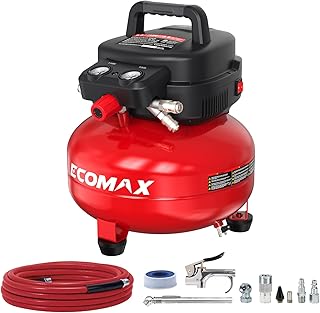
Price: $169.99 | Rating: 4.7
A top-rated pancake compressor with a 6-gallon tank and 150 PSI max. Its oil-free pump reduces drag, and the motor is well-protected against overheating. Includes 10 accessories.
PORTER-CABLE Air Compressor, 6-Gallon, Pancake, Oil-Free (C2002-ECOM)

Price: $164.00 | Rating: 4.6
Industry standard for reliability. Features a high-efficiency motor and thermal overload protection. Many users report zero breaker issues even on shared circuits.
DEWALT Pancake Air Compressor, 6 Gallon, 165 PSI (DWFP55126)

Price: $204.99 | Rating: 4.6
A step up in pressure (165 PSI) and build quality. Includes a high-flow regulator and a low-amp-start motor. Perfect for framing nailers and impact wrenches.
Comparison table:
| Model | Tank Size | Max PSI | Motor Power | Starting Amps (approx.) | Price |
|---|---|---|---|---|---|
| CRAFTSMAN 2 Gal | 2 gal | 125 | 1/3 HP | 8–10 A | $129.99 |
| ECOMAX 6 Gal | 6 gal | 150 | 1.5 HP | 12–14 A | $169.99 |
| PORTER-CABLE 6 Gal | 6 gal | 150 | 1.5 HP | 12–14 A | $164.00 |
| DEWALT 6 Gal | 6 gal | 165 | 1.5 HP | 13–15 A | $204.99 |
If you run mostly cordless tools, consider the DEWALT Tire Inflator Portable Air Compressor 20V MAX (tool only, $130.22) or the CRAFTSMAN V20 Cordless Tire Inflator ($39.00). These battery-powered inflators eliminate breaker tripping entirely.
Internal link: For a full comparison of tank styles, see Pancake, Hot Dog, and Twin Stack Compressors Explained.
Prevention Tips: Keep Your Compressor Running Smoothly
A well-maintained compressor trips fewer breakers. Build these habits into your routine:
- Drain the tank daily – Moisture buildup can short electrical components. Learn the right method in How to Drain Your Air Compressor Tank the Right Way.
- Clean the motor vents – Every month, blow out dust with compressed air or a soft brush.
- Check the power cord – Replace immediately if you see cracks or exposed wires.
- Use proper extension cords – 12-gauge minimum, 25 feet max. Better yet, use a cordless inflator for portable tasks.
- Upgrade to a dedicated circuit – A 20A circuit with 12-gauge wire makes a huge difference. See How to Wire a 240V Outlet in Your Garage.
- Replace worn components early – A bad capacitor or check valve is cheap insurance against a fried motor.
Internal link: Follow the full checklist in Air Compressor Maintenance Schedule: A Monthly Checklist.
Final Thoughts
A tripping breaker is your air compressor’s way of asking for help. Most of the time, the fix is simple—reduce the load on the circuit, replace a cheap capacitor, or clean the motor. But when the motor itself is failing, upgrading to a modern compressor like the PORTER-CABLE C2002-ECOM or the ECOMAX 6 Gallon will save you headaches and downtime.
Remember: safety first. Always work with the compressor unplugged when inspecting electrical components. If you’re unsure about any step, consult a licensed electrician.
Now go fix that breaker—and get back to building.