

Choosing the correct air hose diameter is one of the most overlooked decisions in a compressed air setup. A hose that’s too small starves your tools of airflow, while one that’s oversized adds unnecessary bulk and cost. This guide breaks down exactly what diameter you need, how it affects your tools, and which products pair best with your compressor.
When you buy a starter compressor like the CRAFTSMAN 2 Gallon Portable Air Compressor, it often comes with a small 1/4-inch hose. That’s fine for light tasks, but if you plan to run an impact wrench or a die grinder, you’ll need to upgrade. Understanding hose sizing from the start saves you frustration and wasted money.

Understanding Air Hose Diameters
Air hoses come in four common interior diameters: 1/4 inch, 3/8 inch, 1/2 inch, and, less frequently, 3/4 inch. The number refers to the inside diameter (ID) of the hose, which directly determines how much air can flow through it at a given pressure.
- 1/4-inch hose – lightweight, flexible, best for low-CFM tools like brad nailers, tire inflators, and blow guns.
- 3/8-inch hose – the all-around workhorse for home garages and small shops; handles most impact wrenches, ratchets, and spray guns.
- 1/2-inch hose – heavy-duty for continuous-use tools like sanders, grinders, and paint sprayers requiring high CFM.
- 3/4-inch hose – industrial use only, for high-volume tools and long runs (rarely needed by DIYers).
The trade-off is simple: bigger hose = more airflow but less flexibility and heavier weight. You don’t always need the largest diameter—just the one that matches your tool’s air consumption.
How Hose Diameter Affects Airflow and Pressure Drop
Flow rate is measured in SCFM (Standard Cubic Feet per Minute) at a given pressure (typically 90 PSI). When you connect a hose, friction against the inner wall causes pressure loss. A smaller diameter hose creates more restriction, dropping the pressure your tool actually receives.
Here is a quick comparison of pressure drop across 50 feet of hose at 90 PSI input with 10 SCFM flow:
| Hose ID | Approximate Pressure Drop (PSI) | Best For |
|---|---|---|
| 1/4 inch | 8–12 PSI | Light tools (<5 SCFM) |
| 3/8 inch | 2–4 PSI | Most home/shop tools (5–10 SCFM) |
| 1/2 inch | <1 PSI | High-flow tools (10+ SCFM) |
If your compressor delivers 90 PSI but a 1/4-inch hose drops it to 78 PSI at the tool, an impact wrench may not deliver full torque. That’s why matching diameter to tool requirements is critical.
Matching Hose Diameter to Your Tools
Every pneumatic tool has a CFM rating printed on its spec sheet. Always check that before buying a hose. Here is a practical list of common tools and the recommended hose diameter:
Low CFM Tools (1–4 SCFM) – Use 1/4-inch hose for maximum flexibility.
- Brad nailers, finish nailers
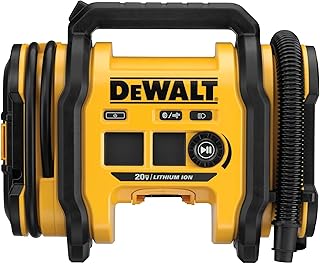
- Tire inflators (including portable units like DEWALT 20V Tire Inflator)
- Air blow guns (e.g., JASTIND Industrial Air Blow Gun)
- Air dusters
Medium CFM Tools (4–8 SCFM) – Use 3/8-inch hose as your baseline.
- 1/2-inch impact wrenches (like those in DYNAMIC POWER 50-Piece Air Tool Kit)
- Air ratchets
- Die grinders
- Orbital sanders
High CFM Tools (8–15 SCFM) – Use 1/2-inch hose to avoid starvation.
- DA sanders
- Paint sprayers (HVLP or conventional)
- Air hammers and chisels
- Industrial blow guns like the High Volume Powerful Industrial Air Blow Gun
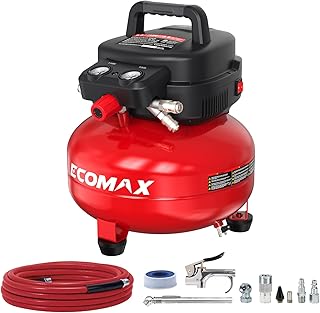
If you own a compact home compressor like the ECOMAX 6 Gallon 150 PSI Pancake or PORTER-CABLE 6-Gallon Pancake, a 3/8-inch hose is usually the sweet spot. These compressors deliver around 2.5–3.5 SCFM at 90 PSI, which is enough for most medium-duty tools with a 3/8-inch hose.

Hose Length vs Diameter: The Trade-Off
Longer hoses increase pressure drop. If you need a 100-foot run, you must compensate with a larger diameter to keep adequate pressure at the tool. For example, a 100-foot 3/8-inch hose loses roughly double the pressure of a 50-foot 3/8-inch hose.
Use this rule of thumb:
- Under 25 feet → 1/4-inch works for light tools
- 25–50 feet → 3/8-inch for most tools, 1/2-inch for high-flow
- 50–100 feet → 1/2-inch minimum for any tool above 4 SCFM
- Over 100 feet → 3/4-inch recommended
Consider the layout of your workshop or garage. If you have a detached garage or a large workspace, you might need a longer hose. In that case, a DEWALT Pancake 6 Gallon 165 PSI (which offers slightly higher pressure) paired with a 50-foot 3/8-inch hose is a common combo.

Material and Fittings: A Quick Note
Hose material affects performance and longevity.
- Rubber – most durable, flexible in cold weather, but heavy.
- Polyurethane – lightweight, flexible, less coiling memory; great for portable use.
- PVC – cheap and light, but stiff in cold and degrades over time.
Fittings also matter: most hoses come with 1/4-inch NPT connectors. If you use a 1/2-inch hose, step-up fittings may be needed. Quick-connect couplers (typically 1/4-inch body) are universal but can restrict flow—consider high-flow couplers for larger hoses.
Real-World Examples: Common Air Compressor and Hose Combos
Let’s analyze the compressors from our data and recommend the best hose diameter for each.
| Compressor Model | Tank Size | Max PSI | Typical SCFM @ 90 PSI | Recommended Hose Diameter |
|---|---|---|---|---|
| CRAFTSMAN 2 Gal | 2 Gal | 125 | ~0.6 | 1/4 inch (for light nailing/tires) |
| ECOMAX 6 Gal | 6 Gal | 150 | ~3.2 | 3/8 inch (general shop use) |
| PORTER-CABLE 6 Gal | 6 Gal | 150 | ~2.6 | 3/8 inch |
| DEWALT 6 Gal Pancake | 6 Gal | 165 | ~2.8 | 3/8 inch |
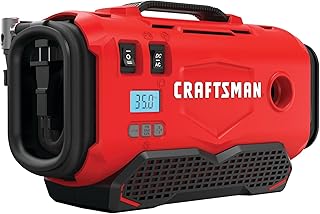
| CRAFTSMAN V20 Cordless Inflator | N/A | 150 | N/A (battery) | No hose needed (direct tire chuck) |
| DEWALT 20V Cordless Inflator | N/A | 160 | N/A (battery) | No hose needed |
For the small 2-gallon CRAFTSMAN, a 1/4-inch hose is ideal for its nail gun kit. The 6-gallon compressors all benefit from a 3/8-inch hose for running impact wrenches or blow guns. If you plan to use a high-CFM tool like a DA sander, you’ll need a 1/2-inch hose and a compressor with higher CFM (not in this list but worth noting).
Cordless inflators like the CRAFTSMAN V20 Tire Inflator or the DEWALT 20V bypass hose sizing entirely. They are perfect for portable tire inflation but cannot run pneumatic tools. For a deeper dive on choosing compressors, see our guide on How to Choose the Right Air Compressor Size for a Home Garage.
Expert Tips for Choosing the Right Air Hose
Follow these steps to nail your hose selection:
- Identify your most demanding tool. Check its CFM rating. Multiply by 1.5 for safety margin.
- Measure the needed hose length. Include vertical climbs or routing around obstacles.
- Select a diameter that keeps pressure drop under 5 PSI at the tool.
- Choose material based on environment: rubber for shop, polyurethane for job site flexibility.
- Invest in high-flow fittings if using 1/2-inch hose or longer runs.
If your compressor oil-free vs oil-lubricated matters for hose care, read our comparison of Oil-Free vs Oil-Lubricated Air Compressors. Oil mist can degrade certain hose materials over time.
Common Mistakes to Avoid
- Using a 1/4-inch hose for a 1/2-inch impact wrench. You’ll get low torque and slow fastening. Upgrade to 3/8-inch at minimum.
- Buying a hose that’s too short. You’ll end up dragging the compressor around. Add 10–15 feet to your estimated length.
- Ignoring coupler restrictions. A standard 1/4-inch coupler on a 1/2-inch hose creates a bottleneck. Use high-flow couplers.
- Mixing incompatible fittings. Ensure your hose ends match your tools; if not, get adapter sets.
When you set up your workshop, also consider Pancake, Hot Dog, and Twin Stack Compressors Explained to understand your compressor’s output.
Conclusion
Picking the right air hose diameter is about balancing airflow, pressure, and practicality. For most home garage users with a 6-gallon pancake compressor, a 3/8-inch hose is the sweet spot. If you only run brad nailers and inflators, 1/4-inch is fine. For heavy-duty sanding or painting, step up to 1/2-inch.
Start by evaluating your tool set and typical hose length. Then match your compressor’s output to the hose diameter that delivers full performance. A small investment in the right hose can transform how well your tools work.
Remember, even the best compressor like the DEWALT 6 Gallon 165 PSI Pancake won’t perform well if choked by an undersized hose. Equip yourself with the correct diameter and enjoy consistent, reliable airflow for every project.
For more compressor maintenance tips, read How to Drain Your Air Compressor Tank the Right Way and Air Compressor Maintenance Schedule: A Monthly Checklist.