
When you shop for a brushless cordless drill, saw, or rotary tool, the spec sheet can look like alphabet soup. Numbers like Kv rating, RPM, and efficiency are often printed on the box, but what do they actually mean for your projects? Understanding these metrics is the key to picking the right tool and getting the most out of your battery investment.
In this article, we’ll break down each spec in plain language, show you how they affect real-world performance, and help you compare top-rated models like the DEWALT 20V MAX Cordless Drill Driver Set (DCD777D1) and the Dremel 8150 8V Cordless Rotary Tool. By the end, you’ll know exactly which numbers matter most for drilling, driving, cutting, and sanding.
What Is Kv Rating?
Kv rating, often written as KV or kV, stands for velocity constant. It tells you how many revolutions per minute (RPM) the motor will spin per volt of applied voltage with no load.
For example, a brushless motor with a Kv of 500 will spin at 500 RPM for every volt. On a 20V battery, that’s 10,000 RPM unloaded. Higher Kv means higher top speed but lower torque at that speed. Lower Kv gives more torque but less RPM.
- High Kv tools (e.g., 800-1000+) are ideal for fast cutting, grinding, or polishing where you need high RPM.
- Low Kv tools (e.g., 100-300) excel at heavy drilling or driving where torque is critical.
Most cordless power tools don’t list Kv directly on the box; instead, they advertise max no-load RPM. That’s your practical reference.
What Does RPM Mean?
RPM (revolutions per minute) is the most visible speed spec on any brushless tool. It tells you how fast the motor or output shaft spins when the trigger is fully pressed and the tool isn’t under load.
No-Load vs Loaded RPM
No-load RPM is useful for comparison, but real-world RPM drops under load. A good brushless motor maintains higher loaded RPM than a brushed motor of the same rating. This is where electronic commutation shines—sensors and controllers adjust power instantly to keep the motor spinning efficiently.
- Drills: often have two speed ranges (e.g., 0-500 RPM low, 0-2000 RPM high).
- Oscillating tools: measure speed in OPM (oscillations per minute), like the DEWALT 20V MAX XR Oscillating Multi-Tool (DCS356B) with up to 20,000 OPM.
- Rotary tools: the Dremel 8150 offers variable speed from 5,000 to 30,000 RPM.
Higher RPM is great for fast material removal, but you often need variable speed control to match the task—brass, plastic, or hardwood all demand different speeds.
Understanding Efficiency Numbers
Efficiency in brushless motors is usually expressed as a percentage (e.g., 85-90% efficient). It describes how much electrical energy from the battery is converted into mechanical power at the shaft. The rest is lost as heat.
Why Brushless Motors Are More Efficient
Brushed motors typically operate at 70-80% efficiency, while brushless motors reach 85-90% or more. That means less wasted heat, longer runtime per battery charge, and higher power density. For deeper insight, see our article on Brushless vs Brushed in Cordless Power Tools: Efficiency, Rpm Control, and Torque Curve Compared.
Key takeaways:
- Higher efficiency = more work per watt-hour. A tool like the DEWALT 20V MAX XR Jig Saw (DCS334B) (3,200 SPM) can run longer on the same battery than a brushed jigsaw.
- Less heat build-up means the tool can handle sustained heavy use without thermal shutdown.
- Battery life is extended because the motor draws fewer amps to maintain the same load.
How These Specs Affect Real‑World Performance
It’s easy to get lost in numbers, but here’s how Kv, RPM, and efficiency translate to your job site or workshop.
Drilling and Driving
For a drill/driver combo like the DEWALT 20V MAX Cordless Drill and Impact Driver 2-Tool Kit (DCK277D2) (ratings 4.8), you want a balance of low speed for high torque and high speed for quick drilling. A brushless motor with a moderate Kv (around 300-600) paired with a two‑speed gearbox gives you the best of both worlds.
- Low gear: high torque for driving 3-inch screws.
- High gear: fast drilling in wood or metal.
The efficiency gains let you drive more screws per charge—especially noticeable on larger projects.
Cutting and Sanding
Oscillating tools and jigsaws rely on RPM/OPM to cut cleanly. The DEWALT DCS356B and its kit variant DCS356C1 offer three speed settings (up to 20,000 OPM) to match material density. A higher efficiency motor maintains those oscillations even when you push the blade into hardwood.
For rotary tools, the Dremel 8250-5 12V Cordless Rotary Tool (ratings 4.7) uses a brushless motor to deliver consistent speed from 5,000 to 30,000 RPM, preventing bogging during routing or engraving.
Torque Curves and Load Handling
Modern brushless tools use sensors to adjust power on the fly. This is exactly where Understanding Torque Curves in Cordless Power Tools with Brushless Motors for Drilling, Driving, and Cutting comes into play. A tool with a flat torque curve maintains high torque even as RPM drops, unlike brushed motors that lose torque quickly under load.
How to Choose the Right Tool
Rather than chasing the highest Kv or maximum RPM, match the spec to your primary use:
| Use Case | Look For | Example Tool |
|---|---|---|
| Heavy drilling | Lower RPM (0-500) + high torque | DEWALT DCD777D1 |
| Fast drilling | Higher RPM (0-2000) + 2-speed | DEWALT DCK277D2 |
| Precision cutting | Variable speed OPM + brushless | Dremel 8150 or 8250 |
| Multi-purpose | 3-speed + high efficiency | DEWALT DCS356C1 |
If you want to understand the inner workings of electronic commutation, read our guide on Cordless Power Tools with Brushless Motors: How Electronic Commutation Really Works Inside the Motor.
Comparison Table of Top Brushless Cordless Tools
Here’s a side‑by‑side look at seven popular brushless models, all from our recommended list.
| Product | Image | Price | Key Specs | Buy at Amazon |
|---|---|---|---|---|
| DEWALT 20V MAX Drill Driver (DCD777D1) | 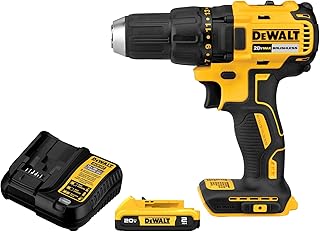 |
$99.00 | Brushless, 1/2″ chuck, 2‑speed, 2.0 Ah battery | Buy Now |
| DEWALT 20V MAX Drill+Impact Combo (DCK277D2) |  |
$169.00 | 2‑tool kit, brushless, impact driver, 2x 2.0 Ah | Buy Now |
| DEWALT 20V XR Oscillating Tool (DCS356B) |  |
$104.99 | Brushless, variable speed, LED, tool‑only | Buy Now |
| DEWALT 20V XR Oscillating Kit (DCS356C1) |  |
$124.50 | 3‑speed, up to 20,000 OPM, with battery & charger | Buy Now |
| DEWALT 20V XR Jig Saw (DCS334B) |  |
$132.00 | 3,200 SPM, brushless, LED, tool‑only | Buy Now |
| Dremel 8150 8V Rotary Tool |  |
$79.99 | 5,000‑30,000 RPM, USB‑C, 20 accessories | Buy Now |
| Dremel 8250-5 12V Rotary Tool |  |
$149.00 | Brushless, 3 Ah battery, variable speed | Buy Now |
FAQ
Is higher Kv always better for power tools?
No. Higher Kv gives more RPM but less torque. For drilling and driving, moderate Kv with a gearbox is often better. For grinding or polishing, higher Kv is beneficial.
What’s the difference between RPM and SPM?
RPM (revolutions per minute) measures rotating tools like drills and rotary tools. SPM (strokes per minute) or OPM (oscillations per minute) measure reciprocating or oscillating tools like jigsaws and multi‑tools.
How do I calculate runtime from efficiency numbers?
Runtime depends on battery capacity (Ah) and motor draw. A 90% efficient brushless motor uses 10% less current than a 80% efficient brushed motor. For a 2.0 Ah battery, you get roughly 11% more work per charge.
Do I need a variable speed brushless tool?
Variable speed is essential for materials that melt or chip at constant high RPM. Most brushless tools include a speed dial or trigger modulation.
Can I replace a brushed tool with a brushless one without changing batteries?
Yes, as long as the battery platform matches. Many manufacturers offer brushless tools that accept the same battery packs as their brushed line.
For deeper electronics, explore Inside the Electronics: How Sensors and Controllers Optimize Cordless Power Tools with Brushless Motors under Load.