
A torque curve reveals the real personality of a power tool. It tells you how much twisting force the motor delivers across its speed range — and that determines whether a drill bites into concrete, a driver sinks a lag bolt, or a cutting tool powers through hardwood. Brushless motors have transformed these curves, giving you flatter torque from start to finish.
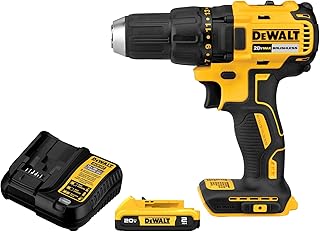
If you are choosing a DEWALT 20V MAX Cordless Drill Driver Set or a compact rotary tool for fine work, understanding the torque curve helps you pick the right tool for each job. Below we break down what torque curves mean, how brushless motors improve them, and which tools excel at drilling, driving, and cutting.
What Is a Torque Curve?
A torque curve is a graph that plots the motor’s rotational force (torque) against its rotational speed (RPM). In brushed motors, the curve typically peaks at a narrow RPM band and then drops sharply. Brushless motors, by contrast, use electronic commutation to maintain higher torque across a wider RPM range, especially at low speeds.
Key terms to know:
- Peak torque – the maximum twisting force the motor can deliver, often at low RPM.
- Stall torque – the torque when the motor is loaded to the point of stopping.
- Constant torque region – the RPM band where torque stays flat (typical of brushless designs).
For drilling and driving, you want high torque at low RPM to start holes and set fasteners. For cutting, you need sustained torque at higher speeds to maintain blade momentum.
How Brushless Motors Affect Torque Curves
Brushed motors lose torque as RPM increases because brushes create friction and arcing. Brushless motors replace mechanical brushes with a controller that adjusts current to each winding in real time. This allows the motor to deliver near-constant torque from low to medium RPM, then gradually taper off at the top end.
The result is a flatter, more usable curve. You get more torque at lower speeds for tasks like drilling into metal, and consistent power for driving long screws without stalling. The same principle applies to cutting tools: a brushless oscillating multi-tool maintains steady oscillation under load, while a jigsaw keeps blade speed even during curves.
To dive deeper into the electronics behind this performance, read our article on Cordless Power Tools with Brushless Motors: How Electronic Commutation Really Works Inside the Motor. For a direct comparison of curve shapes, see Brushless vs Brushed in Cordless Power Tools: Efficiency, Rpm Control, and Torque Curve Compared.
Interpreting Torque Curves for Drilling, Driving, and Cutting
Drilling
Drilling requires high torque at low RPM to start the hole and then enough speed to clear chips. A brushless drill like the DEWALT DCD777D1 uses a two-speed transmission to match torque to the task. In low gear (0–450 RPM) you get maximum torque for driving large bits; in high gear (0–1,500 RPM) you trade some torque for faster drilling in wood and drywall.
Driving
For driving screws and lag bolts, a flat torque curve prevents cam-out and stripped heads. The DEWALT 20V MAX Cordless Drill and Impact Driver Combo Kit (DCK277D2) pairs a drill with an impact driver that delivers high torque bursts at lower RPM, ideal for setting fasteners into dense materials.
Cutting
Cutting tools like oscillating multi-tools, jigsaws, and rotary tools need consistent torque at high speeds. The DEWALT 20V MAX XR Oscillating Multi-Tool (DCS356B) uses a brushless motor to maintain 0–20,000 OPM under load, keeping blade speed steady through wood, drywall, and nails. Similarly, the DEWALT 20V MAX XR Jig Saw (DCS334B) holds torque at 3,200 SPM for smooth cuts in thick materials.
For delicate work, the Dremel 8150 (8V Cordless Rotary Tool) and Dremel 8250-5 (12V Rotary Tool) use brushless motors to keep RPM constant from 5,000 to 30,000, giving you clean cuts and controlled sanding.
Real-World Examples: Torque Curves in Action
DEWALT 20V MAX XR Oscillating Multi-Tool Kit (DCS356C1)

This kit includes the tool plus battery and charger. Its three-speed selector lets you choose the right torque curve for cutting, sanding, or scraping. At $124.50 with a 4.8 rating, it’s a top choice for remodelers.
Dremel 8250-5 12V Rotary Tool

With a brushless motor and variable speed, this $149 rotary tool delivers peak torque at low RPM for grinding and maintains speed for high-RPM cutting. The included 3Ah battery provides extended runtime.
DEWALT 20V MAX XR Jig Saw (DCS334B)

Bare tool at $132, this jigsaw’s brushless motor holds a flat torque curve up to 3,200 SPM, reducing blade deflection during bevel cuts. Users report consistent performance even in 2x lumber.
Comparison Table: Key Brushless Power Tools for Drilling, Driving, and Cutting
| Product | Price | Rating | Key Features | Buy on Amazon |
|---|---|---|---|---|
| DEWALT 20V MAX Drill Driver Set |
$99.00 | 4.7 | 2-speed, 1/2″ chuck, 2.0Ah battery, brushless motor, LED light | Buy Now |
 DEWALT 20V MAX Drill & Impact Driver Combo DEWALT 20V MAX Drill & Impact Driver Combo |
$169.00 | 4.8 | 2-tool kit, 2 batteries, brushless motors, carrying bag | Buy Now |
 DEWALT 20V MAX XR Oscillating Multi-Tool (Tool Only) DEWALT 20V MAX XR Oscillating Multi-Tool (Tool Only) |
$104.99 | 4.8 | Variable speed, brushless, LED, includes 2 wood blades | Buy Now |
 Dremel 8150 8V Rotary Tool Kit Dremel 8150 8V Rotary Tool Kit |
$79.99 | 4.6 | USB-C rechargeable, 5,000–30,000 RPM, 20 accessories | Buy Now |
| DEWALT 20V MAX XR Oscillating Tool Kit |
$124.50 | 4.8 | 3-speed, battery & charger included, up to 20,000 OPM | Buy Now |
| DEWALT 20V MAX XR Jig Saw (Tool Only) |
$132.00 | 4.8 | 3,200 SPM, brushless, LED, keyless blade clamp | Buy Now |
| Dremel 8250-5 12V Rotary Tool |
$149.00 | 4.7 | Variable speed, 3Ah battery, charger & bag | Buy Now |
Tips for Choosing Based on Torque Curve
- For drilling in masonry or metal – look for a drill with high peak torque in low gear (≥500 in‑lbs) and a brushless motor that holds that torque.
- For driving long fasteners – an impact driver with a flat torque curve prevents over-torquing and stripping.
- For cutting – oscillating tools and jigsaws benefit from a brushless motor that maintains RPM under load. Check the constant torque RPM range in the specs.
- For detail work – rotary tools with brushless motors keep speed stable when carving or engraving, even with a bit of resistance.
To understand specs like Kv rating and efficiency, see Decoding the Specs: What Kv Rating, Rpm, and Efficiency Numbers Mean on Cordless Brushless Power Tools.
FAQ
What is the main advantage of a brushless motor torque curve over brushed?
Brushless motors deliver a flatter torque curve, meaning they maintain high torque over a wider RPM range. You get more usable power at low speeds and less drop‑off under load.
How do I read a torque curve spec on a tool?
Look for two numbers: max torque (usually at low RPM) and no‑load speed. Brushless tools often list a “constant torque” RPM band, e.g., “0–500 RPM with full torque.”
Do all brushless tools have the same torque curve shape?
No. The curve depends on the motor’s winding design, controller firmware, and gear ratio. Tools optimized for cutting may have a higher RPM taper, while drilling tools emphasize low‑end torque. Check reviews that include torque curves.
Can I use a drill with a flat torque curve for cutting?
Yes, some drills can drive hole saws or paddle bits, but dedicated cutting tools (oscillating multi-tool, jigsaw) have curves tailored for sustained high‑speed operation without overheating.
Why does torque matter more than RPM for driving screws?
Torque determines whether the screw sinks fully without stalling. RPM only affects speed. A brushless driver with a flat torque curve lets you drive consistently from the first turn to the final seat. Learn about sensor and controller optimization in Inside the Electronics: How Sensors and Controllers Optimize Cordless Power Tools with Brushless Motors under Load.
Conclusion
The torque curve is your tool’s hidden personality. With brushless motors, you get a curve that stays strong and flat where it matters most — at the start of a drill hole, the final turn of a screw, or the steady push of a saw blade. Whether you invest in a DEWALT 20V MAX Drill Driver Set for all‑around work, a DEWALT 20V MAX XR Jig Saw for cutting, or a Dremel 8150 for precision, understanding the torque curve helps you choose a tool that performs exactly how you need.
Look for flat torque specs when possible, and always consider the tool’s intended application. Brushless technology makes a difference you can feel in every squeeze of the trigger.