
Modern cordless power tools with brushless motors deliver consistent performance even when drilling through hardwood or cutting thick metal. The secret lies not in the motor alone, but in the intelligent electronics that sense load and instantly adjust power delivery. Understanding how sensors and controllers work together helps you choose tools that never bog down and extend battery life.
When a brushed motor meets heavy resistance, its carbon brushes waste energy as heat and reduce torque. A brushless motor replaces brushes with an electronic controller that uses sensor feedback to keep the rotor spinning at peak efficiency. This article reveals the engineering inside popular models like the DEWALT 20V MAX Cordless Drill Driver Set and the Dremel 8250-5 Rotary Tool, and explains how they adjust under real-world loads.
The Role of Sensors in Brushless Commutation
A brushless DC motor has three sets of electromagnetic coils arranged around a permanent magnet rotor. To spin the rotor, the controller must energize the right coil at the right time. Hall effect sensors detect the rotor’s magnetic position and send signals to the microcontroller. This real‑time position feedback is the foundation of efficient commutation.
Without sensors, the controller would have to guess the rotor’s position using back‑EMF (a technique called “sensorless” control). While sensorless designs work well at high speeds, they can struggle at start‑up or under sudden load. High‑performance cordless power tools—like the DEWALT 20V MAX XR Oscillating Multi‑Tool—often use Hall sensors for reliable low‑speed torque.
Key benefits of sensor‑based commutation:
- Instant start without cogging
- Smooth torque even at very low RPM
- Ability to reverse direction quickly
The Controller’s Brain: How It Handles Load
The microcontroller in a brushless tool runs firmware that monitors current draw, battery voltage, and sensor data. When you apply heavy load—say, driving a 3‑inch screw into dense oak—the controller sees a spike in current. It responds by adjusting the pulse‑width modulation (PWM) duty cycle and advancing the timing of phase energization.
This closed‑loop control keeps the motor running at its most efficient operating point. Instead of letting the motor slow down and draw even more current, the controller increases torque by fine‑tuning the magnetic field. This is why a brushless drill driver like the DEWALT 20V MAX Cordless Drill and Impact Driver Combo Kit (4.8 stars) maintains drilling speed even as you lean into the tool.
What the controller does under load:
- Raises PWM frequency to maintain RPM
- Advances commutation timing for extra torque
- Limits peak current to protect the battery and motor
- Activates a cooling fan if thermal sensors detect heat
Torque Curves and Constant Power Delivery
A brushed motor’s torque curve drops sharply as speed increases. Brushless motors, thanks to active controllers, can deliver a flat torque curve across a wide RPM range. This is especially important in tools like jigsaws and oscillating multi‑tools.
The DEWALT 20V MAX XR Jig Saw (4.8 stars) uses a variable‑speed trigger that adjusts the controller’s target RPM. When the blade meets resistance, the controller compensates by increasing power without the user needing to press harder. The result is cleaner cuts and fewer blade stalls.
Similarly, the DEWALT 20V MAX XR Oscillating Tool Kit (4.8 stars) features three pre‑set speed modes. Each mode maps to a different load‑handling strategy. The controller uses Hall sensor feedback to keep the oscillation rate steady even when cutting through nails or grout.
Battery Protection and Thermal Management
Sensors don’t only monitor the motor—they also protect the battery. A current‑sensing resistor or a dedicated battery‑management IC sends voltage and temperature data to the main controller. If the tool draws too many amps, the controller reduces power gradually instead of instantly shutting off.
This “soft‑foldback” behavior extends battery cycle life and prevents overheating. The Dremel 8250-5 (4.7 stars) uses a 12V lithium‑ion pack with an integrated PCB that communicates with the brushless controller. When the internal temperature climbs above a threshold, the controller lowers the maximum RPM until conditions are safe.
The Dremel 8150 8V Cordless Rotary Tool (4.6 stars) takes a different approach—it uses USB‑C charging and a smaller battery, but its controller still applies load‑sensing logic to protect the compact cells.
Drilling, Driving, Cutting: How Different Tools Adapt Optimally
Each type of tool requires a unique control strategy. A drill driver needs high starting torque, while a jigsaw prioritises consistent blade speed. The table below compares the electronic features of several top‑rated brushless tools.
Comparison: Top Brushless Cordless Power Tools with Sensor‑Based Control
| Product | Price | Rating | Key Load‑Optimization Feature | Buy at Amazon |
|---|---|---|---|---|
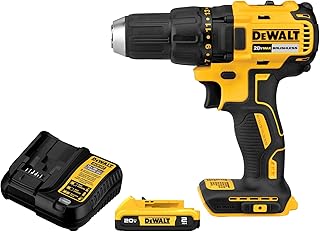 |
$99.00 | 4.7 | 2‑speed gearbox + electronic torque boost under load | View on Amazon |
 |
$169.00 | 4.8 | Two tools with load‑adaptive controllers and shared battery platform | View on Amazon |
 |
$104.99 | 4.8 | Variable speed controller with Hall sensor for constant oscillation under load | View on Amazon |
 |
$79.99 | 4.6 | USB‑C rechargeable; controller limits RPM during heavy carving to protect battery | View on Amazon |
 |
$124.50 | 4.8 | 3‑speed presets with load‑specific timing advance | View on Amazon |
 |
$132.00 | 4.8 | Constant‑speed control with anti‑stall logic for straight cuts | View on Amazon |
 |
$149.00 | 4.7 | Thermal‑sensing controller reduces speed before overheating | View on Amazon |
Why Sensor Quality Matters for Professional Users
Professional tradespeople often push tools to their limits for hours. The DEWALT 20V MAX XR line uses high‑resolution Hall sensors (typically three sensors spaced 120° apart) that provide feedback every few microseconds. This enables the controller to react to load changes within a single motor revolution.
Cheaper brushless tools may use fewer sensors or skimp on signal filtering. The result is a noticeable “judder” when the tool is under heavy load. High‑end controllers, like those in the DEWALT DCS356C1 oscillating tool, implement adaptive commutation—they learn the motor’s inductance profile during the first seconds of use and fine‑tune the switching angles.
FAQ About Sensors and Controllers in Brushless Power Tools
Below are answers to common questions about how the electronics inside brushless cordless tools optimise performance under load.
What types of sensors are used in brushless power tools?
Most use Hall‑effect sensors to detect rotor position. Some high‑end models also integrate current sensors and thermistors for thermal protection.
Can a brushless tool work without sensors?
Yes, sensorless (back‑EMF) control is common in budget tools, but it may cause startup hesitation or torque ripple at low speeds. Tools like the DEWALT DCD777D1 use sensors for smooth start‑up.
How does the controller prevent battery drain?
It monitors current and voltage in real time. If the draw exceeds the battery’s safe limit, the controller reduces PWM duty to avoid deep discharge and overheating.
Does the controller affect runtime?
Absolutely. By keeping the motor in its most efficient operating region, the controller can extend runtime by 20–50% compared to a brushed tool doing the same job. For example, the Dremel 8250‑5’s controller feathers power during light sanding but delivers full torque for carving.
Why do some brushless tools have multiple speed modes?
Each mode sets a different target RPM and a corresponding load‑handling map. Lower speeds use more aggressive timing advance for heavy torque, while higher speeds prioritise smooth, fast cuts.
Further Reading on Brushless Motor Technology
To deepen your understanding, explore these related guides from the same content cluster:
- Cordless Power Tools with Brushless Motors: How Electronic Commutation Really Works Inside the Motor
- Brushless vs Brushed in Cordless Power Tools: Efficiency, Rpm Control, and Torque Curve Compared
- Understanding Torque Curves in Cordless Power Tools with Brushless Motors for Drilling, Driving, and Cutting
- Decoding the Specs: What Kv Rating, Rpm, and Efficiency Numbers Mean on Cordless Brushless Power Tools
Final Thoughts
The electronics inside modern brushless power tools are far more than simple motor drivers. Sensors and controllers work together to sense load, maintain torque, protect the battery, and deliver a consistent experience from first trigger pull to last. When you choose a tool with a sophisticated controller—like the DEWALT 20V MAX XR series or the Dremel 8250—you’re not just buying a motor; you’re buying a smart system that adapts to every cut, drive, and carve.
Whether you’re a professional contractor or a dedicated DIYer, understanding these internal workings helps you pick the right tool for the job and use it to its full potential.